TL;DR
- Design cycles are shrinking. Product complexity is rising. The pressure to lead your engineering organization through an AI transition has never been more specific or more urgent.
- At Synera Connect 2025, engineering leaders from BMW and Airbus were already running agentic AI in production while most of the industry was still in the pilot meeting.
- Synera Connect 2026 is where the conversation moves to the how: how to lead an agentic engineering organization, how to scale past the first pilot, and how to measure impact in terms that matter to engineering leadership.
- Happening on October 8, 2026 at Munich. Request your spot.
Shrinking design cycles, rising complexity, global competition: The pressure every engineering leader is managing now
Most conversations I have with engineering leaders right now start the same way:
- Design cycles that used to span quarters are being compressed into weeks.
- Chinese OEMs are quoting at a pace European manufacturers are still working out how to match.
- Leadership wants an AI strategy.
- The talent pipeline is thinning while product complexity moves in the opposite direction.
The pressure lands in the quarterly review, in the bid that took too long, in the design iteration that should have happened but did not because the team ran out of time. Most engineering leaders, therefore, are not asking whether to act on agentic AI for engineering. They are asking the harder question: what to automate, where to start, and how to know which use case changes the numbers that matter.
Dr. Julien Hohenstein, VP Engineering at BMW, named this shift precisely at last year's Synera Connect:
"It is not anymore a question if you can automate. It is a question which automation do you want, does it make sense, and which has the highest impact." — Dr. Julien Hohenstein, VP Engineering, BMW
That is the question most engineering organizations are still trying to reach. The leaders in that room were already answering it.
The honest state of the market: too much noise, too little clarity
The rational response to the current agentic AI landscape is caution.
Most tools were built for generic knowledge work, not for the fragmented, multi-tool reality of engineering where CAD, CAE, PLM, and costing systems do not talk to each other.
Agentic AI for engineering requires something specific: deep integration with the tools engineers already use, deterministic execution, and context built from real engineering processes.
Synera Connect: Where engineering leaders advancing agentic AI come to compare notes
We started Synera Connect because the knowledge that actually moves organizations forward in this space is not in analyst reports or vendor keynotes. It lives with the practitioners who have already made the transition: the engineering leaders who chose a use case, built a system, put it into production, and now know what works and what the second step looks like.
That is why we keep the event curated deliberately.
Synera Connect brings together VPs, Heads of Engineering, and technical leaders who are navigating this transition, together with the partners and practitioners building with them. The peer connections formed in that room tend to outlast any single session.
We have spent years integrating the tools engineering teams already use with the agentic layer they need to move faster, and we have walked alongside the teams who went first. Synera Connect is where that experience comes back into the room.
What last year's event showed: Three things the industry caught up to in 2026
Synera Connect 2025 was built around a single question: does agentic AI for engineering actually work, and what does it look like when it does? The answer came from three directions.
Engineering AI is structurally different from every other AI domain
Ram Seetharaman, Head of AI at Synera, opened by mapping why engineering AI is harder than any other domain:
- Knowledge is locked in CAD geometry and simulation results.
- Engineers work across dozens of fragmented tools that do not share data.
- Agents need purpose-built integrations to do anything useful in this environment.
"Our Monday mornings could be we enter into a room not full of questions but answers, because the agent already performed all the optimization analysis, trade-offs, talked with other agents, has the information necessary and comes to us with insights." — Ram Seetharaman, Head of AI, Synera
In 2025, this was a vision statement. In 2026, it is a description of how several engineering departments already start their week.
At BMW, the automation question has already moved on
Dr. Julien Hohenstein took the stage at Synera Connect 2025 to describe what BMW's engineering organization looked like on the other side of the decision: process automation connecting engineering IP with agentic performance at scale, and engineers redirected toward the creative and strategic work that compounds.
"The fun is you just delete the non-value adding items. The engineer can focus on creativity, on innovation, on making big steps. This is something that AI is not so strong yet." — Dr. Julien Hohenstein, VP Engineering, BMW
Airbus: 50 hours to under 10 minutes, built in four weeks
Patrick Kunert, Head of Cost Engineering at Airbus, presented six months into a live Synera deployment. The challenge: a tender support process for strategic buyers where expert knowledge was locked in people's heads and data was scattered across:
- Around a hundred specialized software tools.
- Multiple source systems returning conflicting results for the same part.
- Drawings up to 40 years old, some still handwritten and in production.
Synera connected the data sources, automated cleaning and sanity checks, and built a clustering algorithm that grouped hundreds of parts into complexity bins a supplier could actually quote on. The outcome:
"We reduced to below 10 minutes." — Patrick Kunert, Head of Cost Engineering, Airbus
The system brought the whole process to less than 10 minutes, from 50 hours of manual effort per cycle, and it was built in four weeks by two to three engineers.
If you are asking yourself how to make agentic AI work in 2026, Airbus is the blueprint worth studying. The company already built the foundation with workflow automations delivering measurable ROI. Next, adding the LLM layer on top with a team of agents working together would be a small step with a giant impact.
Synera Connect 2026: How do you scale agentic AI for engineering past the first pilot?
Last year answered why agentic AI for engineering matters and showed that it works in production. This year's event is built around the harder question every engineering leader is now facing: how.
- How do you move from a pilot that worked to a transformation that compounds across the department?
- How do you measure AI impact in terms leadership recognizes: output per engineering hour, request for quotation (RFQ) response time, bid win rate, and product delivery milestones?
- What does the pathway from a single use case to an agentic engineering organization actually look like?
These are the questions Synera Connect 2026 is designed to answer: through customer stories, structured sessions on the pathway from pilot to scaled impact, and the peer conversations that happen when the right people are in the same room.
You come in asking how. You leave with the playbook, the peers, and the proof.
Join us at Synera Connect 2026
If you are leading this transition inside your organization, or still working out where to start, I would like you to be in the room.
Synera Connect 2026 takes place on October 8, 2026 in Munich. The event brings together CTOs, VPs, and Heads of Engineering who are actively leading this transition, together with practitioners, partners, and customer organizations building with them. Registration is curated: the room is designed for engineering leaders at or near the frontier of agentic AI for engineering, not vendors or spectators.
Engineering leaders who attend will leave with:
- The frameworks and playbooks for moving from pilot to organization-wide agentic impact.
- Peer connections with engineering leaders who are six to twelve months further along the same journey.
- A first look at where Synera and the broader agentic engineering ecosystem is heading in the coming year.
October 8. Munich. I hope to see you there.
Request to join at synera-connect.ai
FAQs before registering for Synera Connect 2026
What is agentic AI for engineering and how is it different from regular AI tools?
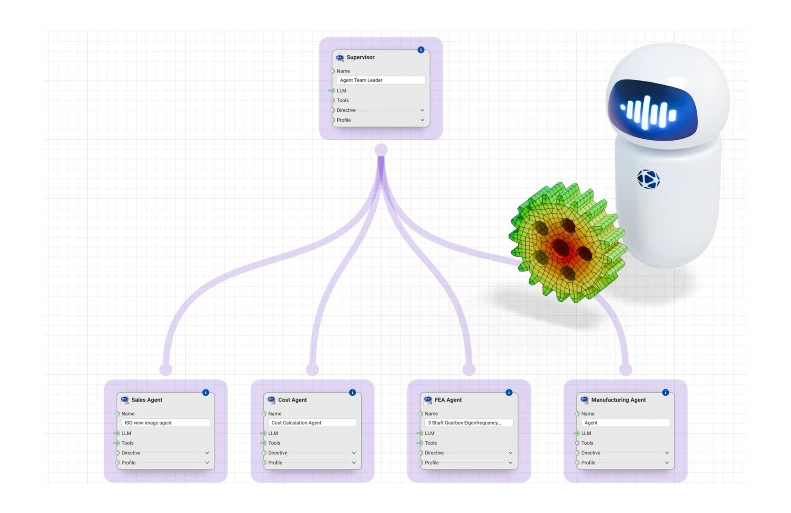
Agentic AI for engineering uses large language models connected to the business-critical tools engineering teams already use (CAD systems, simulation solvers, PLM platforms, costing databases) to execute real engineering work autonomously. Agents evaluate, interpret, and act using workflows built from the organization's own engineering best practices: the logic, the standards, and the domain knowledge that usually lives in engineers' heads.
What will I take away from Synera Connect 2026?
Real stories from engineering leaders already running agentic AI for engineering in production. Structured sessions on scaling from pilot to organization-wide impact. And a first look at where Synera's platform is heading in the coming year, before it is publicly available.
About the Author:

Dr. Moritz Maier
CEO & Co-founder
Dr. Moritz Maier is CEO & Co-founder of Synera. He was fascinated by the connection between technology and entrepreneurship from an early age – founding his first company at 16. His path later led him through scientific research and consulting to the central question that drives him to this day: How can engineers work more intelligently through automation – rather than just faster?
With a PhD in product development processes and experience in generative design, additive manufacturing, and process automation, he now works on the vision of digital engineers: AI agents that support technical development teams and give them more space for innovation.
His approach: Technology should adapt, not the other way around – only then can it truly help people in everyday engineering.