Agentic AI & Automation Trends in Engineering
How Agentic AI reshaped engineering in 2025 - and the trends and actions leaders need to stay competitive in 2026.
1. Introduction: The Year Research Met Reality
For years, artificial intelligence in the engineering sector remained confined to the laboratory, in a 'research' phase characterised by experimental chatbots and isolated pilot programmes. However, the end of 2025 saw the definitive 'implementation chasm'. While many organisations remained stuck in the novelty phase, industry leaders began to scale up. Data confirms a critical strategic imperative: in 2025, 33% of use cases were still novelty-driven, but nearly 45% of agentic systems had moved into production-ready environments. Some organisations achieved 95% process coverage through AI-assisted workflows.
As we look towards 2026, the question is no longer whether AI can be used in engineering, but rather why some companies have flourished while others have stagnated. The difference lies in the strategic shift from 'chat' to 'execution'. Those who succeeded moved beyond theory to embrace a world in which digital colleagues navigate complex, fragmented tool chains to deliver tangible enterprise value.
2. Software 3.0: A New Paradigm for Automation
Ram Seetharaman, Head of AI at Synera, characterizes this shift as the emergence of Software 3.0. This isn't just a version update; it is a fundamental architectural transition ported from the software industry to the engineering domain. The paradigm follows a precise formula:
High-Quality Model + Context + Tooling = High Automation
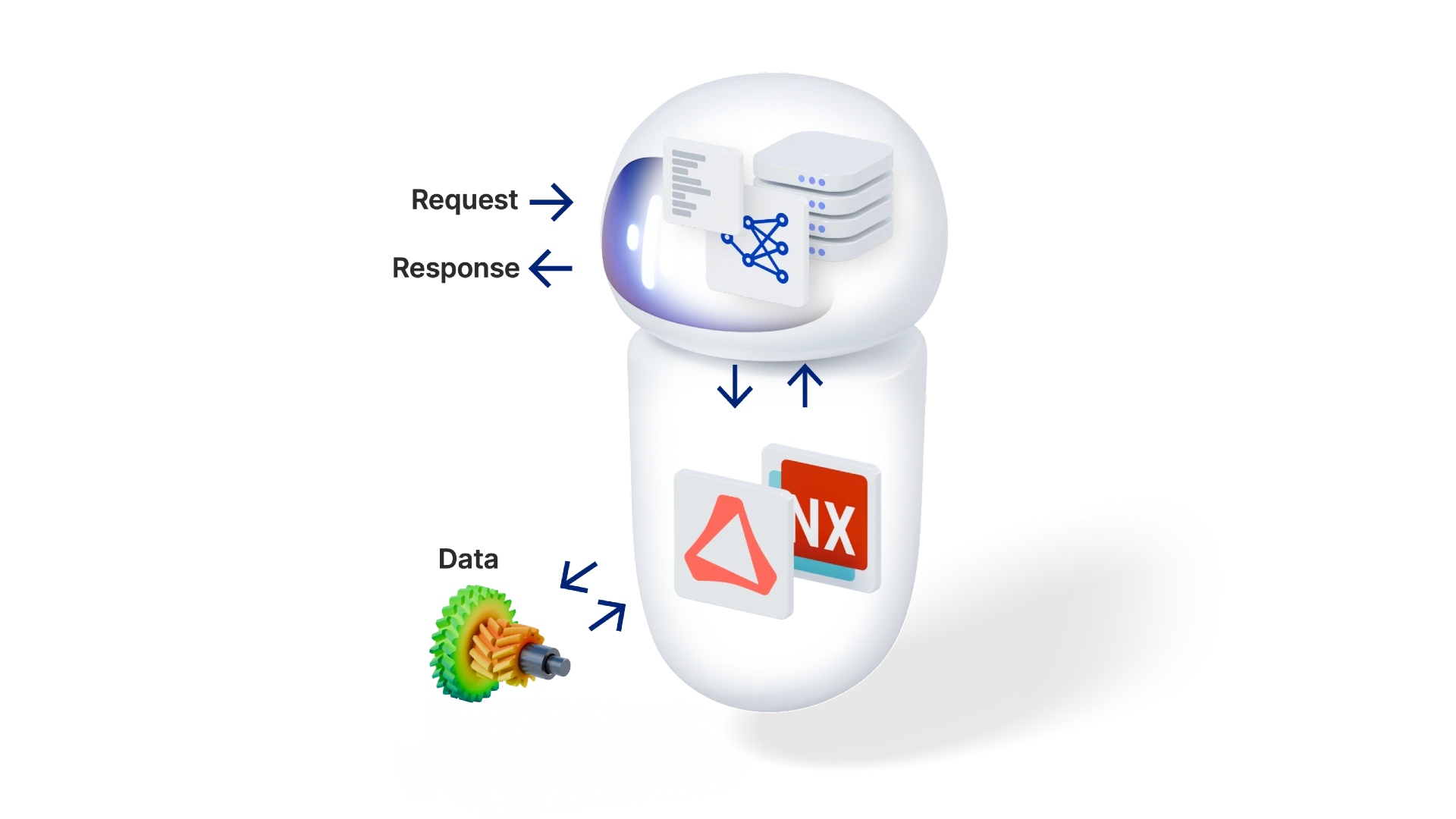
The "context" layer is the essential bridge between a non-deterministic Large Language Model (LLM) and a deterministic engineering environment. In Software 3.0, context isn't just memory; it is the integration of legacy data, past decisions, and internal standards that reduces the "reliability barrier." By providing the AI with specific organizational context and a robust tool layer, we move from general-purpose assistants to specialized systems capable of automating the resolution of complex engineering problems.
Software 3.0... if you have a good model, if you have good context, and you have good tooling to code, much of it can be highly automated. This is a good proof point that this formula can also work in our domain. - Ram Seetharaman
3. The Horizontal Advantage: Breaking Engineering Silos
Research conducted by Dirk Molitor, in collaboration with DFKI and Fraunhofer, analyzed 137 scientific publications to map the maturity of AI in engineering. The study revealed a stark contrast between "Vertical" and "Horizontal" integration:
- The Vertical Status Quo (Fragmented): Most current AI applications are designed to solve specific problems within a single domain (e.g. generating requirements or optimising a single part). While these 'vertical' solutions are useful, they are often trapped in departmental silos and rely on fragmented data.
- The 2026 Horizontal Advantage (Connected): This approach seamlessly connects data and tools throughout the entire product development lifecycle, from requirements to architecture, simulation and manufacturing.
The data confirms that the highest value for the enterprise is found in the top-right corner of the research maturity plot. Multi-agent systems are the only technology currently achieving high maturity in both vertical and horizontal planes. Organizations that embrace horizontal integration are seeing accelerated development cycles that allow them to compete with the aggressive production speeds of global competitors.
4. Overcoming Data Silos with Multi-Agent Systems
The primary driver for rethinking the traditional "V-model" is the prevalence of late and error-prone integration. Historically, errors are identified too late in the development process, leading to massive cost overruns. Multi-agent systems address this by serving as the "connective tissue" between tools.
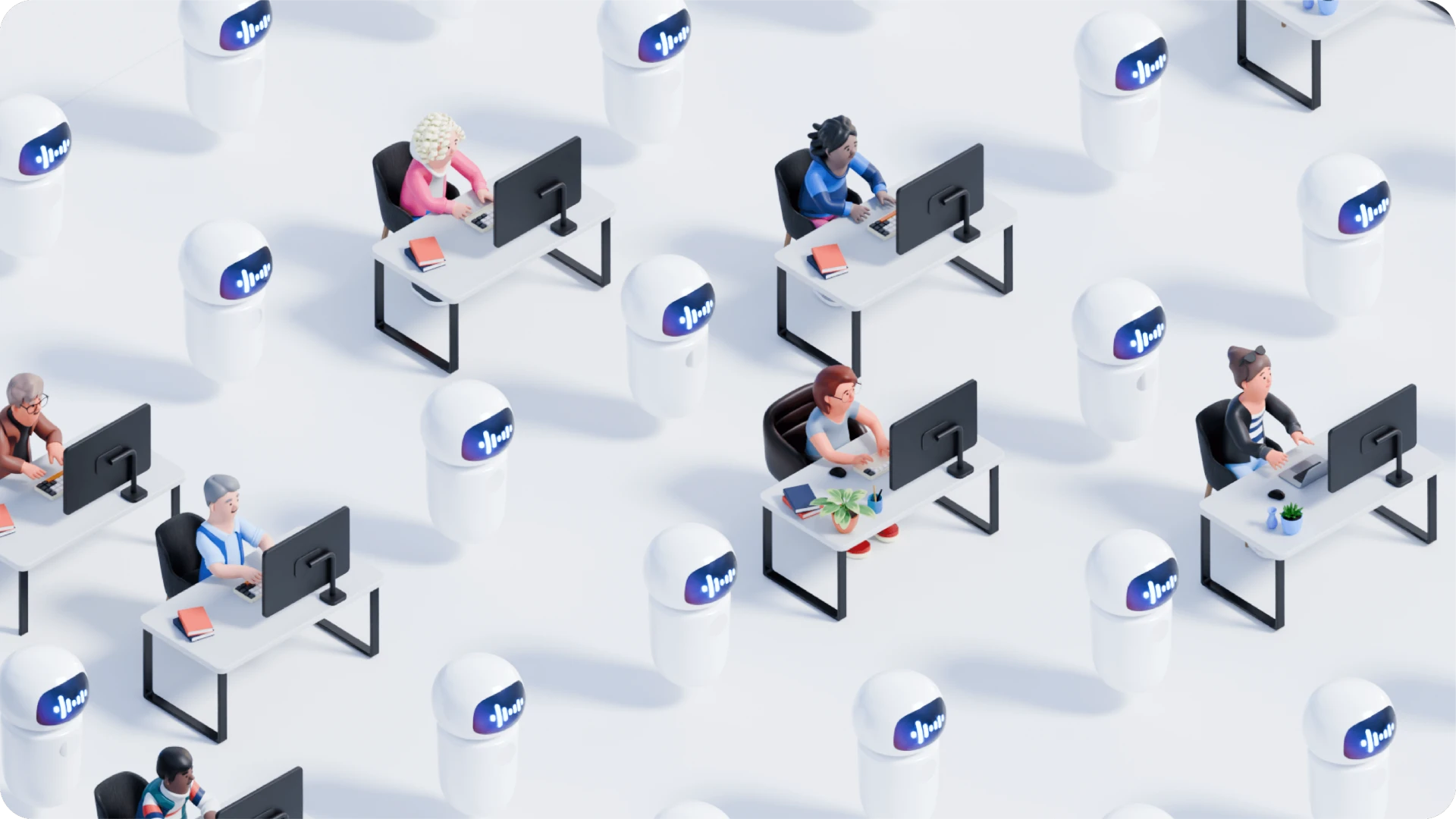
Using the Model Context Protocol (MCP) and Vision Language Models (VLMs), these systems deploy "digital coworkers" that act as specialized departments. Supported by knowledge graphs and Reasoning-Action (RAC) solutions, these agents make fragmented engineering data machine-readable. They navigate silos that humans previously had to bridge manually, ensuring that a change in the requirement domain is immediately reflected in the simulation and CAD layers.
5. 2026 Strategic Bets
The experts outlined three primary predictions for the coming year:
#1: The Evolution of Human-AI Collaboration
The first major strategic bet for 2026 is the transition from "Human-in-the-loop" to "Human-on-the-loop." We are moving away from a model where engineers perform the bulk of manual tasks with AI assistance. Instead, agents will execute the majority of the workflow, utilizing an escalation path to reach out to experts only when they encounter "complex issues" or high-uncertainty decisions.
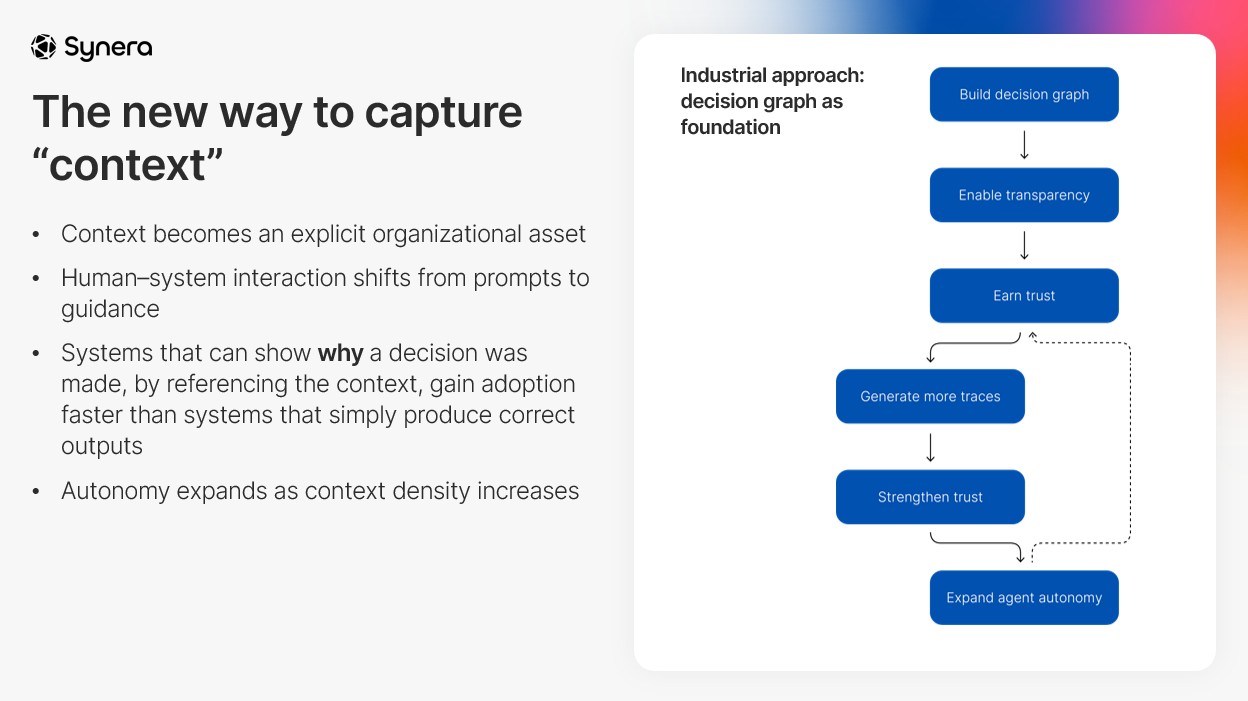
This creates a high-level review process where the engineer’s role is to guide and validate rather than execute. This collaboration forms a critical feedback loop: every human correction serves as new, unique context that trains the agent, making the system more robust and uniquely tailored to the organization's specific engineering DNA.
#2: Physics-Aware Spatial Models
The industry is moving beyond 'text-to-mesh' models that only generate aesthetically pleasing 3D shapes. The 2026 frontier is defined by geometric foundation models pioneered by industry leaders such as NVIDIA that are inherently physics-aware.
Unlike earlier 3D models, these new spatial models understand:
- Mechanical forces and stress distribution
- Material properties and mass distribution
- Fracture patterns and structural integrity
For an Innovation Strategist, this is the ultimate leap: AI that doesn't just "draw" a part but understands if that part will fail under load. This physics-awareness ensures that AI-generated geometry is manufacturing-ready and structurally sound from the first iteration.
#3: Compilable Product Development
Product development is shifting toward a code-based generation model, or "Compilable Engineering." This mirrors the software development lifecycle, moving away from manual geometric manipulation in a GUI toward a "Text-to-X" workflow.
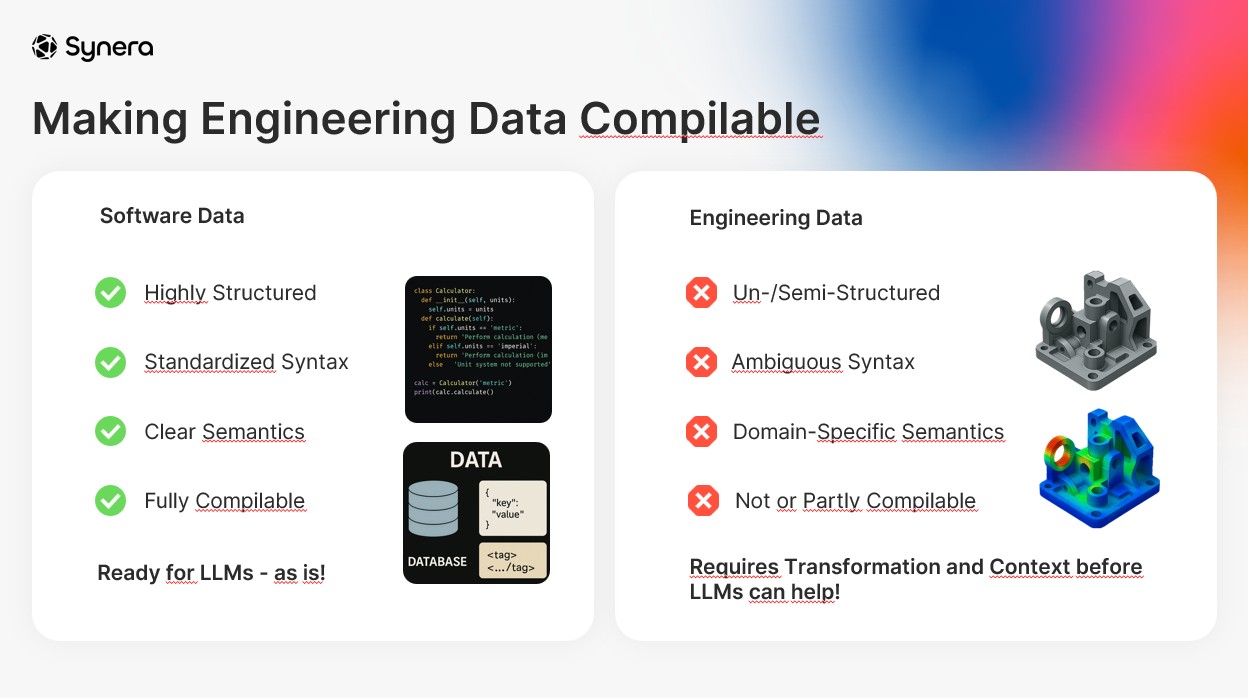
In this paradigm, engineers use agents to generate textual notations, such as SysML v2 or Python, utilising libraries from start-ups like Zoo or specialised CAE tools. This code is then 'compiled' into CAD models or simulation setups. This shift from graphical modelling to textual notation enables:
- Perfect machine-readability for LLMs.
- Version control and structured semantics.
- Rapid parameterization, where agents modify code to iterate on designs at speeds impossible for manual 3D modeling.
6. The Behavioral Hurdle: Building AI-Native Organizations
The technology for 2026 is ready; however, the human and organizational structure remains the most significant bottleneck. To compete with the rapid development cycles seen in the Chinese market, Western engineering firms must transition into AI-native organizations.
An AI-native structure is one where the organization supports its engineers through rapid transformation rather than tethering them to legacy processes. This requires rethinking the V-model to accommodate the non-deterministic nature of AI. Success will be determined by how quickly leadership can move from "novelty pilots" to an environment that embraces digital coworkers as a competitive necessity.