
Gartner® Manufacturing Predicts 2026
The High Stakes of Agentic Automation, Digital Threads, and Rising IT Costs

As digital transformation enters a new inflection point with the emergence of agentic AI, executives are increasingly focused on understanding what comes next: the integration of semiautonomous AI agents, closed-loop digital twins, and software-defined products linked by PLM-based digital threads. At the same time, leaders must account for rising IT systems costs as AI vendors move from experimentation to monetization.
The new Gartner report, Manufacturing Predicts 2026: AI Agents, Digital Twins and the Race to Autonomous Operations, offers a forward-looking perspective on engineering technology, the convergence of OT and IT data, and the steps manufacturers can take prepare, balancing cost pressures while accelerating toward autonomous, AI-enabled operations.
Key Findings:
Agentic Automation, Digital Threads, and the Economic Reality of Vendor Lock-in
- 40% Faster Time-to-Market: Decoupling hardware from software allows for parallel development. In 2026, manufacturers adopting this "shift-left" strategy are already reducing time-to-market for mechatronic products, with long-term projections reaching up to 40%.
- The Digital Thread: Looking ahead of 2026 to 2030, an estimated 30% of manufacturers will utilize PLM-based digital threads. These threads provide the high-quality, contextualized data, including product names, formulations, packaging, labeling, and safety information, required for effective AI model training and "right first time" regulatory submissions.
- The Rise of the Agentic AI: As digital transformation programs progress, Gartner predicts: “by 2030, semiautonomous AI agents will orchestrate 10% of key production operations, quality and maintenance use cases — up from 2% today — while humans retain final approval.”
- Navigating the 40% Cost Escalation: The shift to autonomous AI will catalyze an estimated 40% increase in core system costs before the end of the decade, as vendors include “machine users” in their pricing models. Gartner notes that, "Deeper lock-in with incumbent enterprise-wide platform providers encourages users to seek lower-cost technology providers offering high cloud-native AI value.”
To lead in the age of AI, leaders must balance rising IT costs and technology risks with the operational gains offered by agentic orchestration. Read the Gartner report to learn about analysts’ findings and recommendations.
How leading manufacturers are responding to 2026 trends
Leading manufacturers are responding to the shift toward autonomous operations by fundamentally restructuring their engineering processes, organizational teams, and vendor relationships. Rather than viewing these trends as isolated and fragmented projects, they are prioritizing AI transformation on their executive agendas, treating the convergence of AI agents, digital twins, and software-defined products as a "new genetic code" for their digital strategy.
Download the report
Synera’s approach to agentic AI in engineering
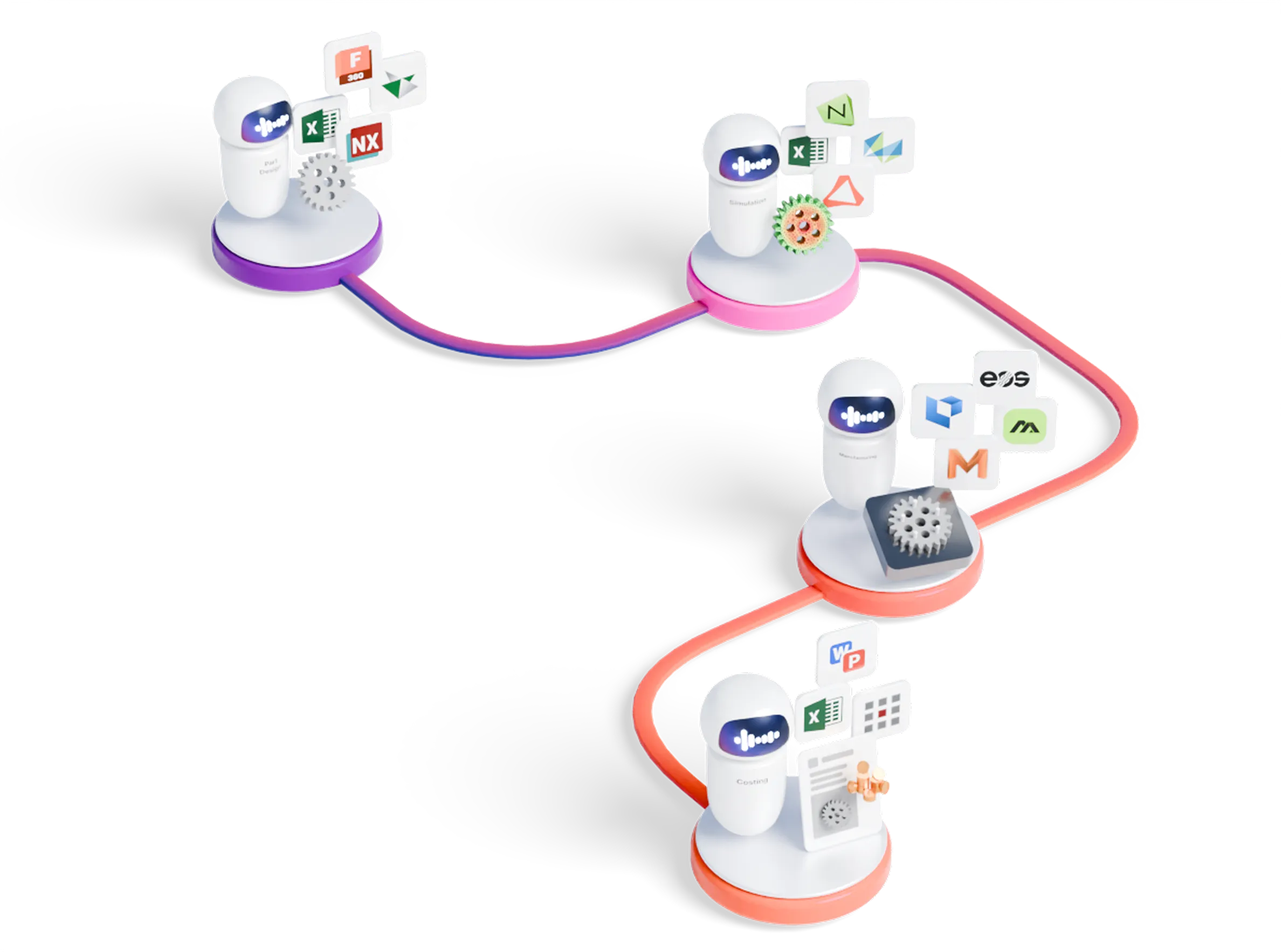
Synera AI agents are specialized digital engineers that handle the heavy lifting of repetitive engineering tasks and tool orchestration. Agents iterate hundreds of complex trade-offs, propelling product development teams forward with validated concepts and completed reports.
Synera accelerates both your digital transformation and time-to-market, securing a sustainable competitive advantage for you and unleashing R&D innovation in your organization.
No more endless pilots and skyrocketing costs. Just an AI workforce that does what it’s intended to do.
Frequently Asked Questions: The Future of Autonomous Manufacturing
A digital thread is a collaborative information framework that connects product and process data across the enterprise, including R&D, manufacturing, quality, and supply chain. It functions as one half of a “DNA double helix,” where one thread defines the product and the other orchestrates production, enabling faster adaptation to changing requirements. Product Lifecycle Management (PLM) is foundational, aggregating high-quality, contextualized data that supports AI model training and right-first-time regulatory compliance.
Core manufacturing IT costs are projected to increase by up to 40% in the next three years. Key drivers include new AI monetization models such as fees for “machine users,” rising inflation, increased reliance on cloud infrastructure for compute-intensive AI workloads, and the high cost of deeply integrated PLM platforms.
By the end of the decade, semiautonomous AI agents are expected to orchestrate about 10% of production, quality, and maintenance activities, up from roughly 2% in early 2026. These agents take on manual execution, shifting human roles to strategic oversight. AI agents are also reshaping engineering by accelerating product development and helping address skills and capacity gaps.
Executives should prioritize the following actions:
- Decouple hardware and software: Adopt software-defined architectures and develop hardware and software in parallel (shift left) to reduce time to market by up to 40%.
- Unify data foundations: Build a contextualized, agent-ready data foundation and establish a digital twin integration team to align IT, OT, and engineering data standards.
- Manage vendors: Audit master license agreements, cap price increases, and negotiate flat pricing for machine users to improve cost predictability.
- Establish governance: Define clear levels of AI agency across assets and processes, with human oversight retained for safety- and compliance-critical decisions.
Gartner, Manufacturing Predicts 2026: Digital Twins, AI Agents, and the Race to Autonomous Operations, 10 December 2025, Alexander Hoeppe Et Al.
GARTNER is a registered trademark and service mark of Gartner, Inc. and/or its affiliates in the U.S. and internationally and is used herein with permission. All rights reserved.