The manufacturing industry is no longer debating whether agentic engineering works. Early adopters have moved past pilots, are seeing measurable results, and are now replicating agentic AI solutions across their organizations. The transformation is mainstream, and the focus has shifted from "will this work?" to "how do we deploy this at scale, responsibly, across our existing engineering stack?"
That question is harder than it sounds. With all the AI options available today, finding a platform that can seamlessly deploy integrated agentic engineering solutions in hardware manufacturing remains one of the biggest challenges for engineering leaders.
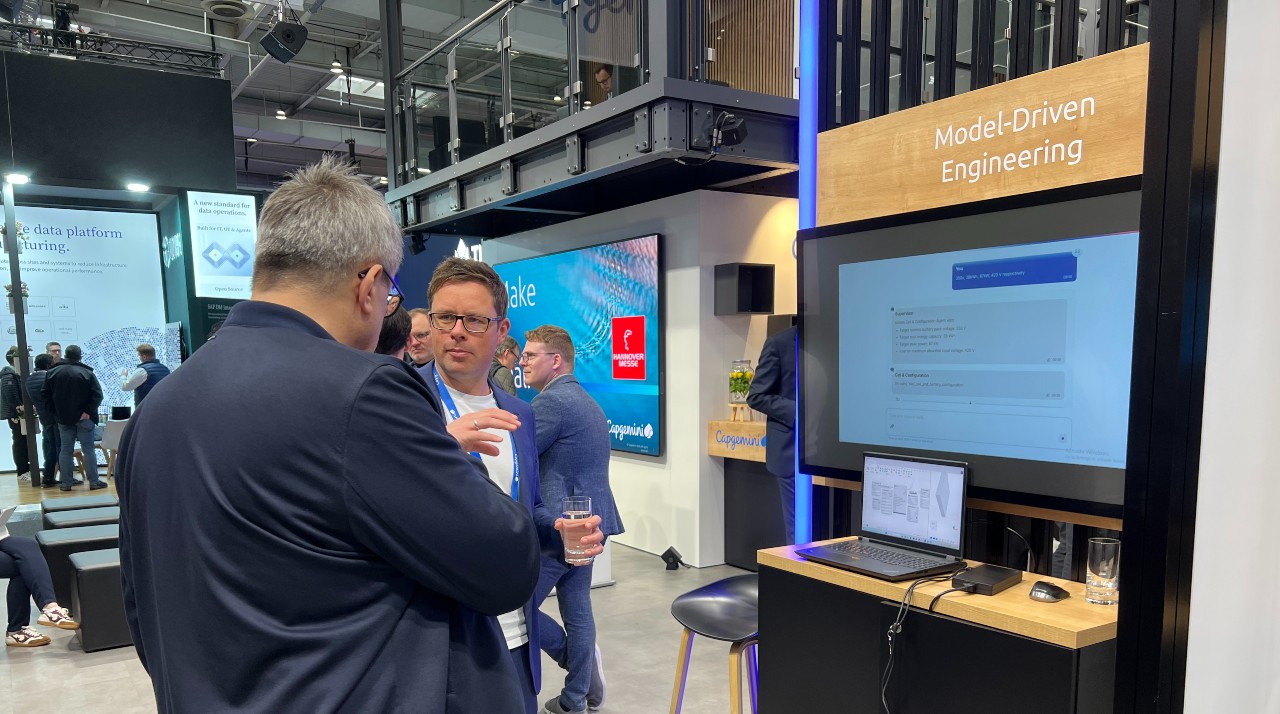
At Hannover Messe 2026, the world's leading trade fair for the manufacturing industry bringing together over 4,000 exhibitors and 130,000 visitors from 150+ countries, Synera showcased its agentic AI solutions for R&D engineering alongside its strategic investor and collaborator, Capgemini. Synera's CEO and Co-Founder, Dr. Moritz Maier, joined Natalja Schuler Boehm, Head of Ecosystem Growth and Success at Siemens Xcelerator; Jean-Pierre Roux, CEO at Dessia Technologies; and Jacques Bacry, Global Head of PLM Practice and Global Offer Lead for Digital Continuity at Capgemini, on a panel discussing the AI engineering stack.
TL;DR: Building an AI engineering stack is not straightforward, especially in hardware manufacturing. Engineering operations span fragmented tools, siloed knowledge, and processes that AI systems can't fully comprehend or act on. We know that building the right AI engineering stack is one of the most complex high-stakes decisions engineering leaders face right now.
This piece breaks down what industry leaders from Synera, Siemens Xcelerator, Dessia Technologies, and Capgemini agreed on at the panel, and how Synera's live Agentic AI for engineering demo lived up to the principles in practice.
The state of AI engineering stack: What the industry's leading voices agree on
Agentic AI deployment in engineering isn't just a technology problem. It demands nuance, deep engineering expertise, and a relentless focus on quantifiable customer value over visionary demonstrations.

At the panel, leaders from Synera, Siemens Xcelerator, Dessia, and Capgemini converged on four principles that separate agentic AI programs that scale from those that stall.
Synera: The unit of engineering work must shift from isolated tasks to executable, governable workflows, and that transformation requires equal investment in technology and organizational enablement. Agentic programs that chase value creation rather than deliver it don't survive contact with real-world engineering products. The platforms that do are LLM-agnostic, tool-agnostic, and built to connect with the critical tools and data engineers already use.
Siemens Xcelerator: Black box AI has no place in engineering production workflows. Without traceability, governance, structured data, and digital continuity baked into the foundation, organizations end up with an accumulation of AI pilots that never convert into revenue-generating programs.
Capgemini: The most deployable agentic AI solutions are built on top of existing engineering tools, not as replacements for them. Most manufacturing organizations have worked with their toolchains for decades. They want an agentic layer that synchronizes with what they have, not one that disrupts it.
Dessia: Engineering is fundamentally about decisions. AI's highest value in engineering isn't automation for its own sake: it's enabling better, well-informed decisions and opening up solution spaces that engineers wouldn't have reached on their own.
These aren't aspirations from observers. They come from organizations that have already deployed functional agentic AI in large hardware manufacturers across automotive, aerospace, and home appliances. What they described is the filter through which engineering leaders are qualifying solutions today.
Synera was built against every one of these principles. At Hannover Messe, a live demo of Synera's agentic AI system designing a battery pack from scratch made that case seamlessly.
Watch: Synera agentic AI system designing a battery pack from scratch
In this four-minute demo, Synera's agentic AI system creates a battery pack from a natural language input combined with technical boundaries and requirements to a complete engineering report autonomously.
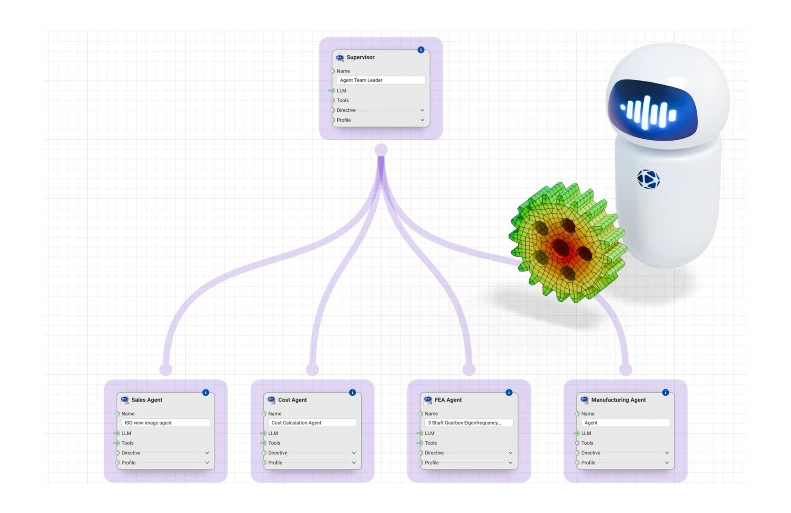
A Supervisor agent orchestrates a crew of six specialized agents: Cell & Configuration, CAD, Thermal, FEA, Costing, and Report. Each agent has defined responsibilities, explicit rules, and reasoning boundaries.
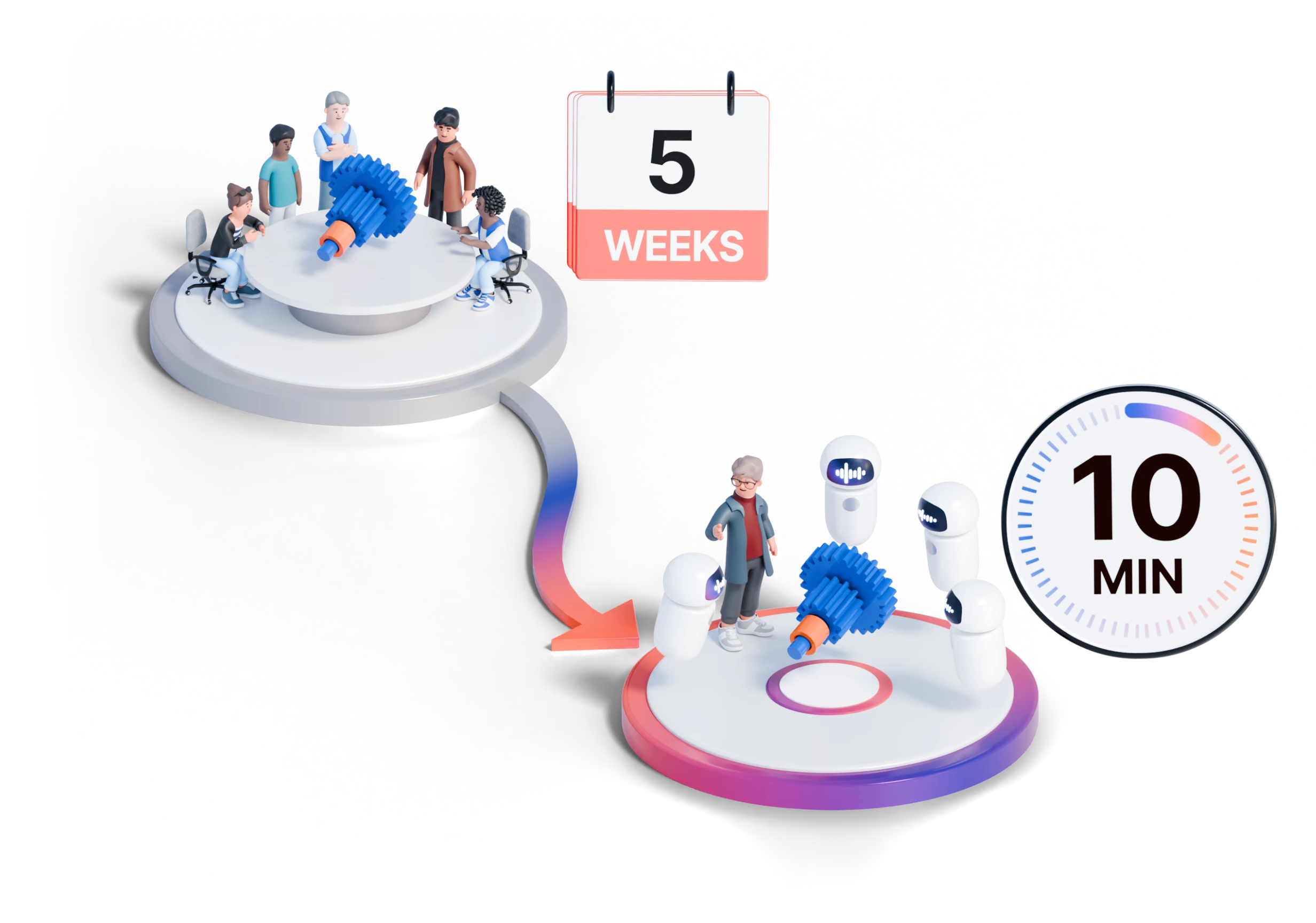
Synera’s agentic AI system has evolved beyond a prototype, and it is currently in deployment across major automotive, aerospace, and consumer goods manufacturers, compressing engineering workflows that typically span days of manual coordination into a single, governed, automated run.
How Synera ticks every box: From principles to practice
Most agentic AI platforms are built for software. Synera was built for engineering, from the ground up, for the specific constraints, tools, and decision-making processes that hardware manufacturers deal with every day. Connecting with 80+ CAx and PLM tools, Synera's agents don't replace the engineering stack: they work inside it, taking over the manual and repetitive work so engineers can focus on problem solving and innovation that actually move products and companies forward.
Every agentic AI system Synera deploys is built on a foundation of rule-based, deterministic workflows. They are created by first digitalizing and optimizing the existing engineering processes of an organization, then connecting to critical tools for geometry creation, simulation, FEA, and costing, and finally layering LLMs for governed decision-making without manual handoffs at each stage.
The battery pack demo offers a concrete illustration of what each of these principles looks like when they move from panel discussion into a working engineering system.
Traceability: no black boxes, full audit trail
- The Supervisor agent narrates every step of the process, from the inputs taken from the engineer to the outputs delivered to each specialized agent and back.
- Every agent operates within explicitly defined responsibilities, reasoning boundaries, and hard constraints set by the engineering team.
- The engineer stays in control throughout. When the engineer chose to skip the Thermal agent and proceed directly to FEA, the system respected the override immediately and rerouted the workflow without breaking the chain.
- Every geometry change, simulation result, and calculation remains visible and accessible in the Synera UI. Nothing is abstracted away from the team that needs to validate it.
Built on your existing tools, not instead of them
- Synera's integration with 80+ CAx and PLM tools wasn't an afterthought. It was a founding architectural decision.
- Engineering organizations have decades of process knowledge encoded in their toolchains. Synera was built to be future-proof, not to create lock-in.
- In the battery pack demo, each specialized agent operates through Synera's run workflow tool, interfacing directly with existing toolchains while respecting the hard constraints that engineering teams have developed from experience.
- The organization's engineering IP (its processes, parameters, and constraints) is preserved and put to work, not replaced.
Structured workflows first, AI on top
- Agentic AI is only as reliable as the foundation it runs on. Synera's deployment methodology begins by digitalizing existing engineering processes into rule-based workflows. In doing so, it gives engineering leaders the tools to simplify, enhance, and automate those processes through AI-assisted workflows, before layering LLMs for fully agentic execution.
- In the battery pack demo, the Cell & Configuration agent evaluates user-defined criteria and hard rules, not approximations. The CAD agent receives structured geometry inputs.
- Each transition between agents is a structured data event, not a free-form exchange. The agents didn't improvise; they executed against a governed foundation.
Synera begins every engagement with a thorough use-case assessment to identify the right level of agentic engineering for each process, ensuring that AI is introduced where it creates the most value, not just where it's technically possible.
The winners will build on principles, not promises
Manufacturing leaders are evaluating if agentic solutions in front of them can meet the standards that enterprise deployment actually demands traceability, existing tool integration, structured foundations, and proven value over pilots.
At Hannover Messe, these principles validated by organizations already operating agentic AI in production environments, and Synera's live battery pack demo was one such validation, running the full design cycle from natural language input to engineering report in four minutes.
Stay ahead of where agentic engineering is going with the Synera newsletter (look for it in the footer).
Want to see how the agentic AI system looks for your workflows? Book a demo with Synera experts.