The US hardware manufacturing sector is facing a paradox. More than $1.5 trillion has been committed to building new factories on American soil. Reshoring is surging. Geopolitical pressure, tariffs, and supply chain fragility are all pointing production back home. And yet, nearly half a million manufacturing jobs sit unfilled today, with a projected shortfall of 2.1 million skilled workers by 2030.
The factories are being built. The engineers aren't there to run them.
That gap, between the ambition of American manufacturing and the reality of its workforce, is precisely where agentic AI enters the picture.
The reshoring boom is real, but the talent shortage is costing you speed, capacity, and revenue.
The market reality
We are living through a genuine moment of industrial reinvestment. Reshoring Initiative data shows tariff citations as a driver of reshoring jumped more than 450% in Q1 2025 versus a year earlier. Automotive, aerospace, and advanced hardware manufacturers are all signaling domestic investment at levels not seen in generations.
But commitment announcements and shovel-ready sites don't solve the fundamental constraint. Across automotive and aerospace R&D teams, anywhere between 40 to 50% of engineering time goes toward process coordination, rework, and lower-value tasks rather than the design and innovation work your organization actually needs to move faster.
Skilled engineers are scarce, aging, and distributed unevenly, and a shortage of skilled R&D engineers is posing a serious threat to the revenue. Capgemini research says that 44% of executives believe their organizations risk losing significant market share within five years if they cannot accelerate innovation.
The pressure is building on two fronts. In aerospace, Deloitte projects US spending on AI will reach $5.8 billion by 2029, 3.5 times current levels, because the industry already understands it cannot scale production rates on human capacity alone. In automotive, the engineering complexity per vehicle has exploded with the transition to software-defined vehicles, while the pipeline of systems engineers has not kept pace.
Agentic AI is the competitive edge. Here is what separates it from the AI you already have.
Most engineering organizations have experimented with AI in some form. Generative AI tools have proven genuinely useful for documentation, code assistance, and knowledge retrieval. But these are augmentation tools. They make individual engineers faster. They don't fundamentally change the capacity equation.
Agentic AI is categorically different. Here is what that distinction actually means in practice:
- AI copilots assist a workflow. They respond to prompts, surface information, and accelerate discrete tasks within a single tool or environment.
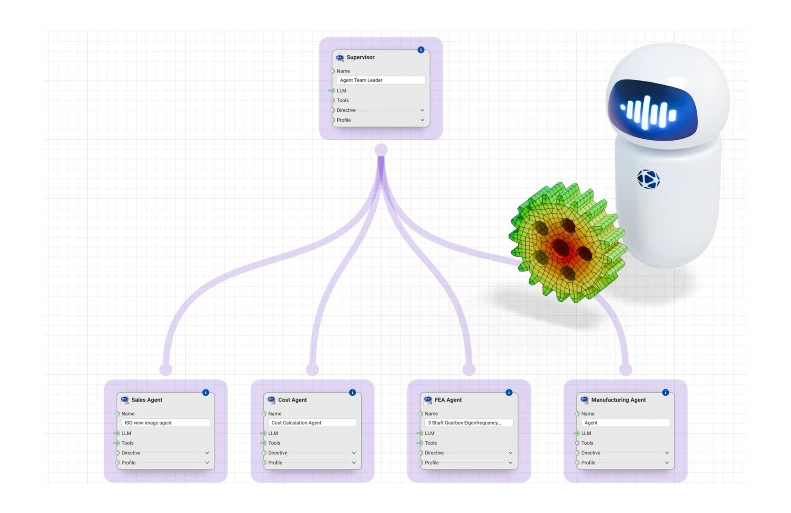
- AI agents execute workflows. They reason, plan, and take multi-step actions across systems autonomously, triggering simulations, interpreting outputs, rerouting to alternative tools, and delivering results without waiting for a human to initiate each step.
For an aerospace OEM managing 500 or more engineering software vendors, this difference matters enormously. One makes individual engineers faster. The other makes the entire engineering organization faster and expands capacity.
Why agentic AI is the answer, and why now
I spent over two decades at Ansys, Altair, and Siemens. I have sat across the table from engineering leaders at the world's largest automotive and aerospace organizations. I know what the competition is building, and I know what their roadmaps look like. The window of differentiation is narrow, and it is closing faster than most executives realize.
Late in 2024, agentic AI barely registered as a term in most engineering circles. Within a few months of digging in, the pattern became undeniable. Companies restructuring around AI productivity were seeing their engineers operate at a pace and scale that made the old benchmarks irrelevant. The signal was clear enough that I joined Synera specifically to be at the front of it.
Here is what I keep telling every room I walk into: the organizations moving on agentic AI now are not running experiments. They are building an operational lead that compounds every quarter. There is a learning curve, and the systems only get smarter and more efficient with use. Every quarter you wait is a quarter your competitors are moving ahead of you. McKinsey's data confirms it: 62% of mid-sized and large businesses are already experimenting with agentic AI systems, and 23% are actively scaling them.
The experimentation phase is over. What separates leaders now is execution.
Agentic AI orchestration across critical engineering tools: What the manufacturing leaders seek
Individual AI copilots within existing tools don’t have the scaling potential to impact time-to-market. We are seeing an increasing demand for an intelligent layer that spans across the engineering stack of PTC, Ansys, Altair, Siemens, and Dassault and connects them to a unified AI orchestration platform.
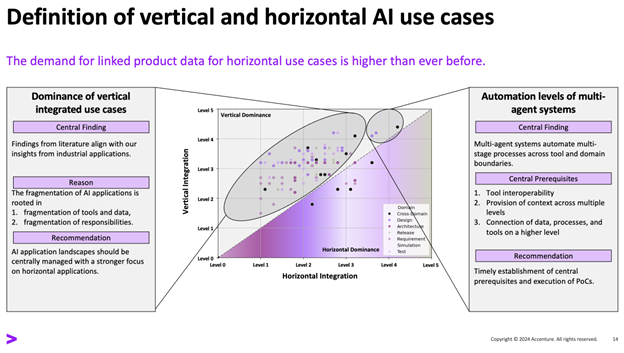
According to Deloitte, 36% of tasks across manufacturing are already candidates for augmentation through agentic AI. IDC forecasts that by 2028, 65% of G1000 manufacturers will integrate AI agents directly into their design and simulation tools, enabling continuous validation of design changes against product requirements and significantly reducing costly late-stage redesigns.
This is precisely the gap Synera was built to close, connecting over 80 engineering tools under a single agentic orchestration layer without requiring you to replace the infrastructure you have already invested in.
Here is what agentic AI actually looks like running inside a hardware engineering team
The abstractions around AI agents can obscure what the technology actually delivers. Here is what it means for your R&D engineering operations.
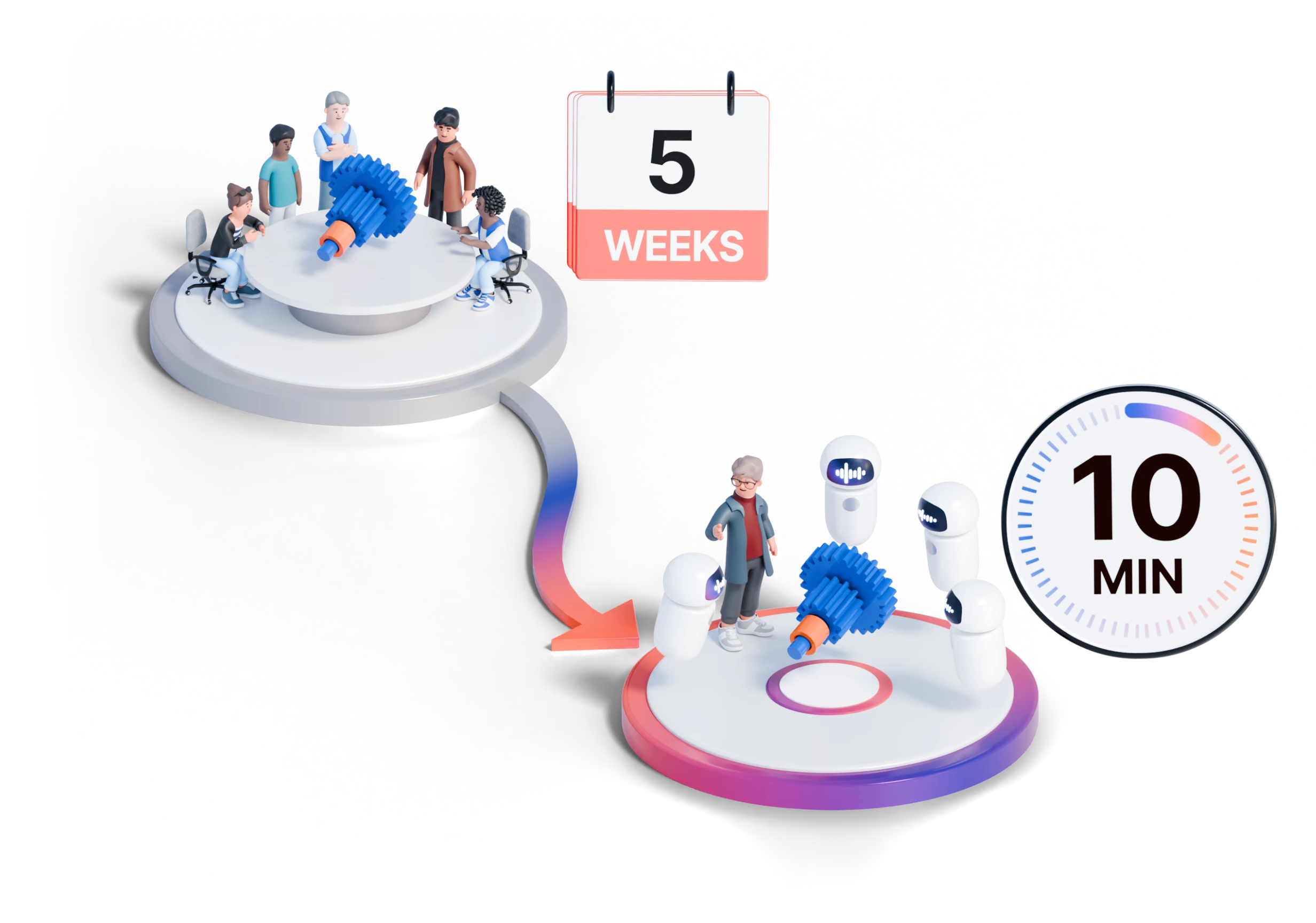
In a conventional setup, a structural analysis workflow alone can involve an engineer manually extracting geometry, configuring simulations, waiting on results, interpreting outputs, and cycling back through the process repeatedly. Each hand-off and consumes time your engineers could be spending on higher-order problems. Engineering workflow automation at this level is precisely what agentic AI makes possible.
With an agentic AI system, that entire workflow runs autonomously from start to finish, with the agent escalating only the decisions that genuinely require human judgment. The result is engineering capacity that scales. That matters when your hiring pipeline cannot keep pace with your production commitments.
The critical enabler is the integration layer underneath the AI model, not the model itself. Your engineering organization is running dozens of software tools across your development process. You need agents that operate across all of them, not just inside one vendor's ecosystem. The best AI in the world, deployed inside a single-vendor silo, does not solve the cross-tool orchestration problem that is consuming your engineering team's capacity right now.
This is the gap that defines the current opportunity, and why your evaluation of agentic AI needs to start with an orchestration platform, like Synera.
The organizations deploying agentic AI now are building a lead that compounds every year
The workforce constraint is not going away. The Reshoring Initiative's own data found that a stronger skilled workforce would bring back more US production than any tariff level, weaker dollar, or tax cut.
If you are leading an automotive OEM or a tier-one aerospace manufacturer navigating that reality, agentic AI is the most credible lever available to you right now.
Deloitte predicts a fourfold increase in agentic AI adoption in manufacturing by the end of 2026. The organizations at 24% adoption will not look like the ones still at 6%. They will have encoded their best processes into repeatable, scalable workflows. They will have captured institutional knowledge before it walked out with a retiring engineer. They will be doing more with the engineering talent they already have, which is exactly what your moment demands.
The lead is being built now: Where are you in it?
The manufacturers defining the next decade of hardware leadership are not waiting for the perfect hire, the ideal budget cycle, or the technology to mature further. The window is moving, and every quarter of inaction is a quarter of compounding disadvantage.
Ready to take your AI strategy to the next level? I invite you to talk to one of Synera's AI engineering experts and follow us on LinkedIn to stay ahead of what is coming.
About the Author:

Ubaldo Rodriguez brings over 25 years of engineering software market expertise to Synera, where he leads revenue strategy and go-to-market execution as Chief Revenue Officer. He specializes in bringing transformative technologies into mainstream adoption across aerospace, automotive, and manufacturing, with previous senior leadership roles at PTC, Agile Software, Ansys, and Altair. At Synera, Ubaldo works with global engineering leaders at organizations to integrate agentic AI into their engineering workflows — helping teams move faster, reduce inefficiency, and accelerate time-to-market.