Industrial manufacturing is under intense time and cost pressure: increasing product complexity, a shortage of skilled workers and ever shorter delivery times are forcing companies to rethink their approach. Terms such as "China Speed" illustrate that time is becoming a decisive competitive resource – especially in the automotive industry. Software-based process automation is thus becoming a key lever for efficiency and productivity.
Synera addresses these challenges with process automation software that relieves engineering teams of repetitive, non-value-adding tasks. Instead of investing time in manual routines, engineers can focus more on innovation. A key advantage lies in the broad software integration: with over 70 connectors to common engineering tools such as Siemens NX, Abaqus, Moldflow and Eosprint, as well as an RPA add-in for automating UI-based applications, Synera closes existing automation gaps along the entire engineering workflow.
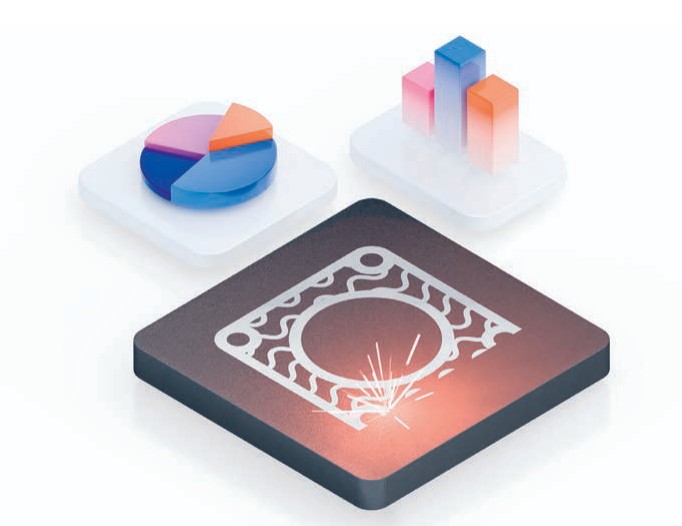
to create extensive automation and AI agents
and easily visualise complex results, even without programming knowledge.
A practical example from the automotive industry clearly demonstrates the potential: a leading car manufacturer used Synera to optimise the development of customised, 3D-printed robot grippers. By automating design and manufacturing processes, weight and wear were significantly reduced. The gripper weight was reduced by around 30 per cent (approx. 50 kg), which increased the service life of the robots and reduced emissions. At the same time, production times and costs were significantly reduced. A gripper can now be manufactured using 3D printing within 22 hours – a clear competitive advantage with an annual production of over 300,000 parts. Compared to conventional processes, CO₂ emissions were reduced by around 60 per cent.
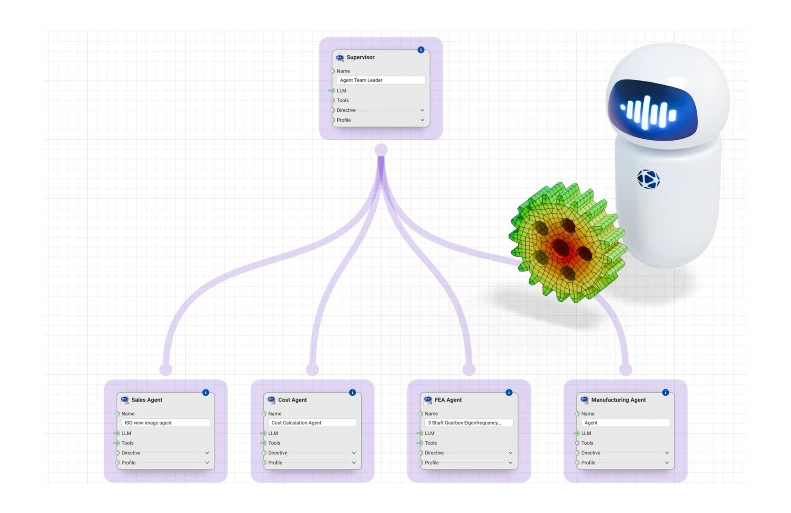
Going beyond classic automation, Synera is focusing on the next stage of development: AI Agents for Engineering. These combine the cognitive power of modern large language models with direct access to CAD, CAE and ERP systems. The agents act as digital manufacturing partners that perform tasks independently, make decisions and automate processes around the clock. In multi-agent systems, they work like a virtual engineering team – without breaks and without scaling limits.
AI agents really show their potential in the RFQ (request for quote) process. Quotation processes that used to take weeks can now be drastically shortened. In additive manufacturing, build preparation, nesting, support generation and simulation can be fully automated. Companies like NASA are already using these approaches productively.
The bottom line: agent-based manufacturing is not a vision of the future, but a real competitive advantage. It reduces costs, shortens development and quotation cycles, increases efficiency and gives companies more time for innovation – a decisive factor for long-term competitiveness.