Every year, the AI predictions roll in and engineering leaders are left trying to separate signal from noise, deciding which bets are worth making and which can wait.
So we did something different. We put Accenture's Dr. Dirk Alexander Molitor, and Synera's own Head of AI, Ram Seetharaman and myself Daniel Siegel (CPO) in the same room and asked: what actually happens next in agentic AI for engineering? Then we compared it to Gartner® analysts’ research to see where their views converge and where they split.
Most AI in Engineering Is Too Narrow
Before getting to 2026 predictions, Dirk brought hard data on what has actually worked. Accenture, together with the German Association for Artificial Intelligence and Fraunhofer, reviewed 137 scientific publications on AI in engineering to map what kinds of applications were delivering real results.
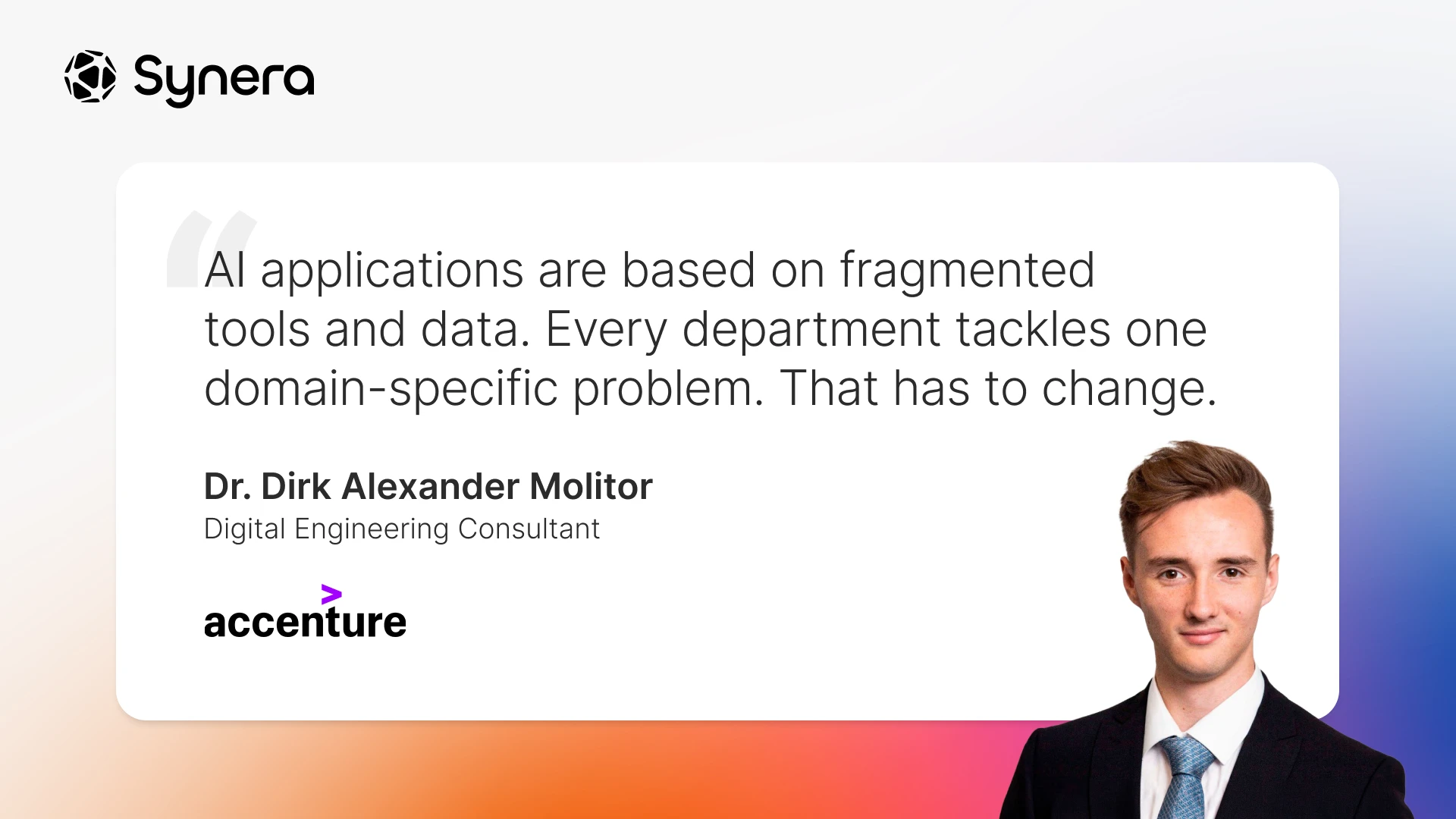
The pattern was striking. Most AI applications in engineering solve problems within a single domain, one tool, one team, one step in the process. They go deep but not wide. And that, Dirk argued, is exactly why so many AI initiatives stall. They optimize a corner of the process without connecting it to anything else in the engineering value chain.
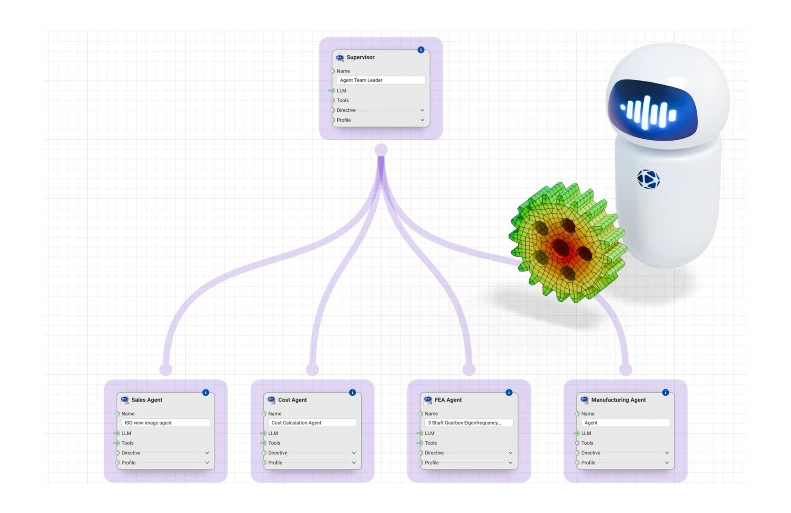
The AI successes that broke through, achieving what Accenture calls high vertical and horizontal maturity, all shared one characteristic: they used multi-agent systems. Teams of specialized AI agents that could collaborate across tools, data types, and engineering domains. Not just smarter copilots, but connected ones.
That finding reframes the whole future of AI in engineering. It is not a question of whether to use AI. It is a question of whether your AI agents can work together across engineering domains.
You can watch Dirk present and discuss the results with Ram and me in the on-demand webinar, Agentic AI & Automation Trends in Engineering.
Two Areas Where Gartner, Accenture, and Synera All Point in the Same Direction
With that foundation in place, two areas of agreement emerge across all experts, and they are worth paying attention to precisely because they are not coming from one voice.
1. The first is human-AI collaboration as infrastructure.
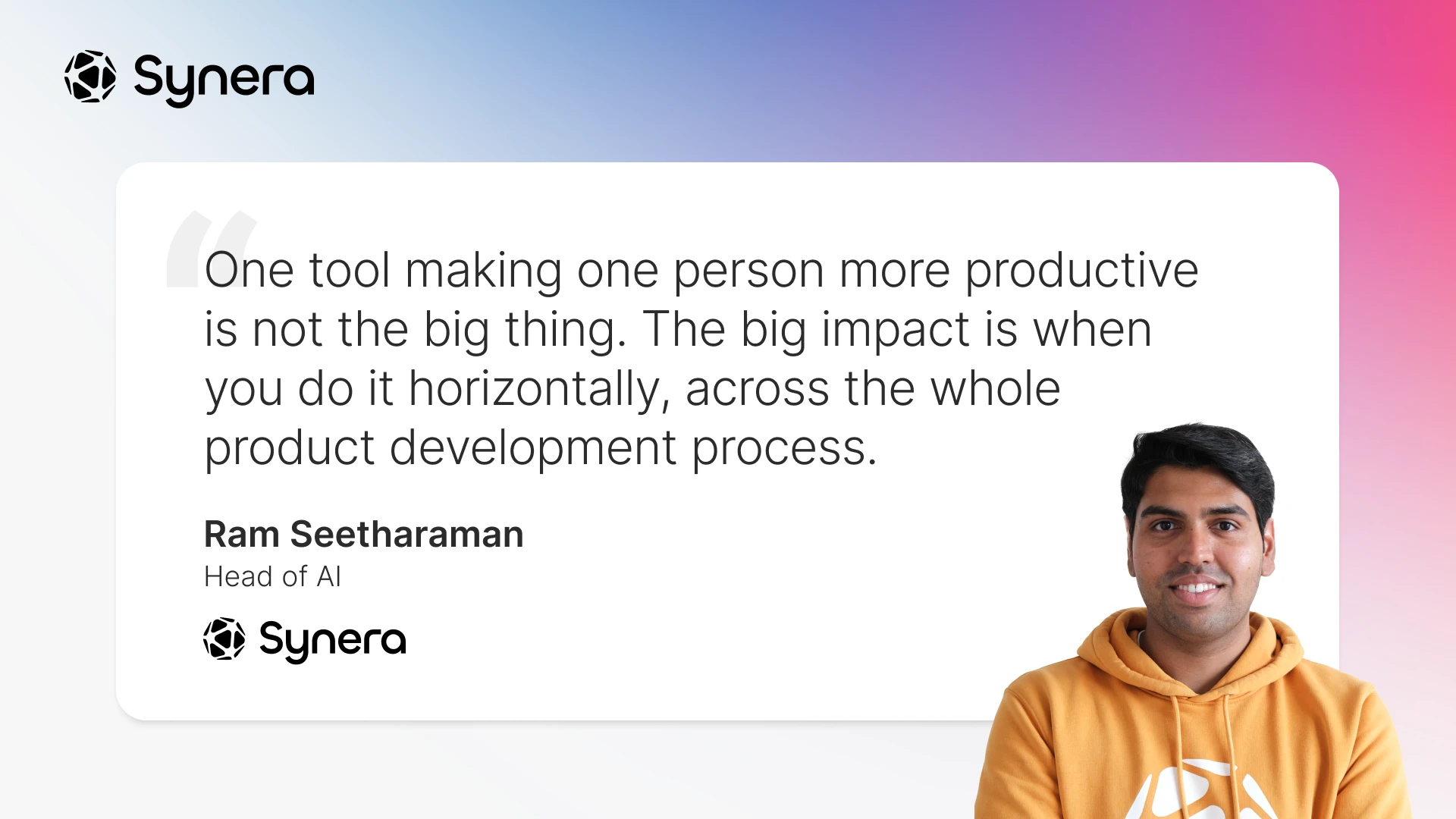
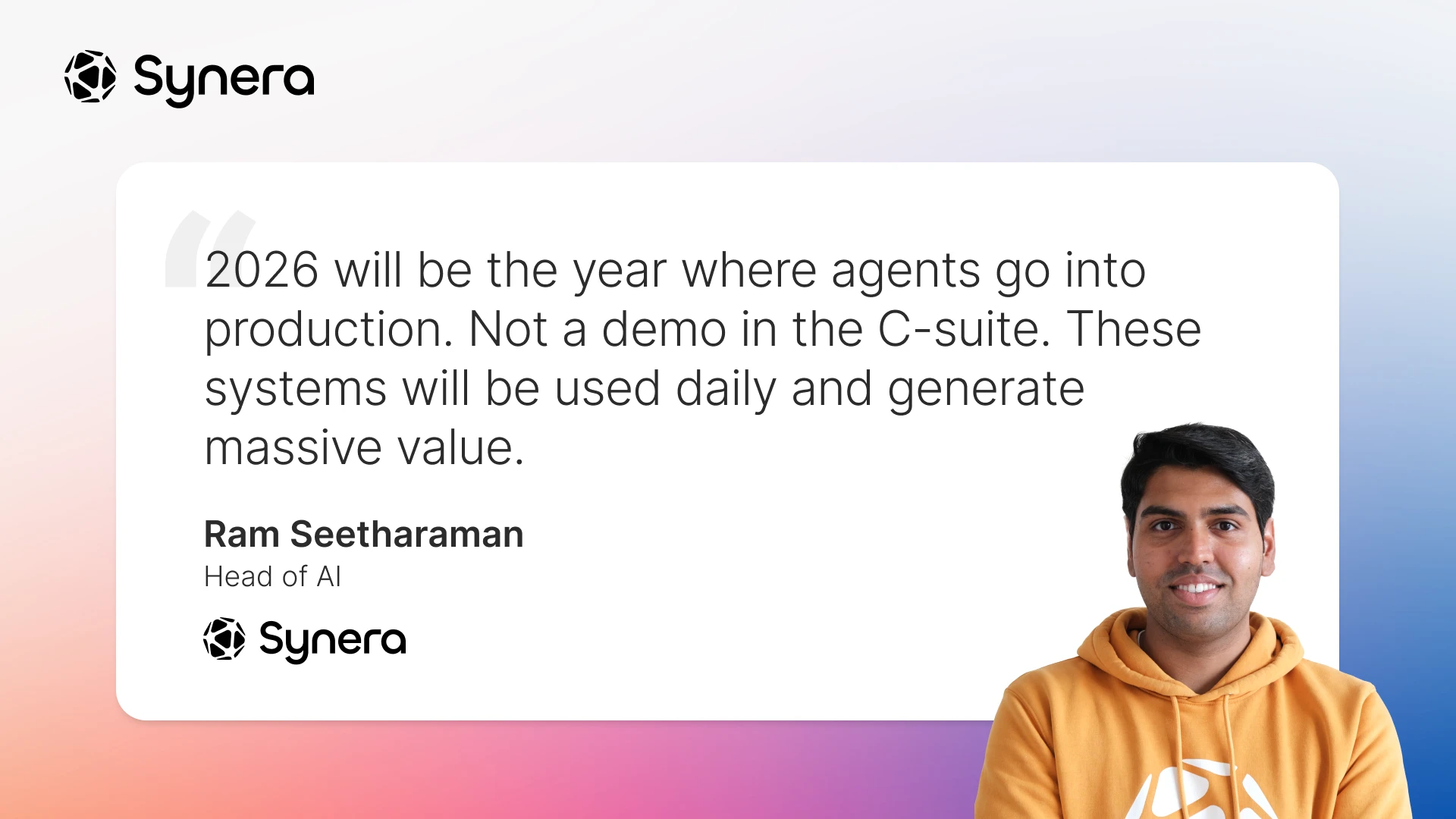
Synera’s Head of AI, Ram predicts for 2026 that organizations will move from hoping humans and agents work well together to solidifying that relationship. That means leaders building hybrid AI-human teams, structured escalation paths, feedback loops, and transparency into what agents are doing and why.
Gartner's forecast puts numbers behind it: “semiautonomous agents will handle roughly 10% of production, quality, and maintenance decisions by 2030, up from around 2% today, with humans retaining final approval.”
Accenture’s research shows the same pattern from the bottom up: the highest-performing AI applications already depend on human-defined processes and cross-domain coordination to function. The collaboration is not optional; it is what makes the whole system trustworthy.
2. Don’t build agents on top of fragmented, domain-locked engineering data
The second convergence is on data. All three perspectives land in the same place: you cannot build capable agents on top of fragmented, domain-locked engineering data.
Accenture’s Digital Engineering Consultant, Dirk named tool interoperability and multi-level context management as the central prerequisites for effective agentic AI systems. Ram’s and mine also forecasted engineering data becoming more compilable, through text-to-CAD, text-to-simulation, and standards like SysML v2 that shift from graphical notation to text that large language models (LLMs) can actually parse.
Gartner estimates that 30% of manufacturers will depend on PLM-based digital threads by 2030 for exactly this reason. The data foundation is not just a technical initiative, but necessary for agentic AI to succeed at scaling.
Where They Diverge: Two Blind Spots Worth Knowing About
Not every expert covered the same ground, and the gaps are as informative as the overlaps.
1. Physics-aware 3D foundation models
Ram predicts that the next generation of generative engineering models will not just produce geometry. They will produce geometry that understands mechanical forces, material properties, and structural behavior. Companies like Nvidia are already pushing hard in this direction. It is Synera's most forward-leaning prediction, and neither Gartner nor Accenture's research touches it. Ram will offer a deeper perspective on this in an upcoming deep dive. Blog subscribers will get this sent straight to their inbox.
2. Software cost control
This prediction come from one of the foremost experts on the subject: Gartner. Analysts forecast a 40% increase in core system costs before 2030, driven by vendors pricing in "machine users" and deepening lock-in with incumbent platforms. The recommendation is to act now: audit your master license agreements, cap price escalation clauses, and negotiate flat pricing for machine users before those terms are set for you. For any leader making AI adoption decisions alongside technology decisions, underlying systems costs belongs in the same conversation.
The 360-Degree View for Engineering Leaders
When you you put all three expert sources together:
- Accenture shows where the industry has been: most AI in engineering is too siloed to scale, and the applications that broke through did it with connected systems.
- Synera shows you where agentic AI technology for engineering is heading: natural human-agent collaboration, physics-aware generative models, and engineering data that agents can work with natively, across domains.
- Gartner shows you the economic reality waiting on the other side: meaningful operational gains, and a cost structure that will catch unprepared organizations off guard. For all the details and recommendations from the analysts, download a complimentary copy of the Gartner research, Manufacturing Predicts 2026: AI Agents, Digital Twins and the Race to Autonomous Operations.
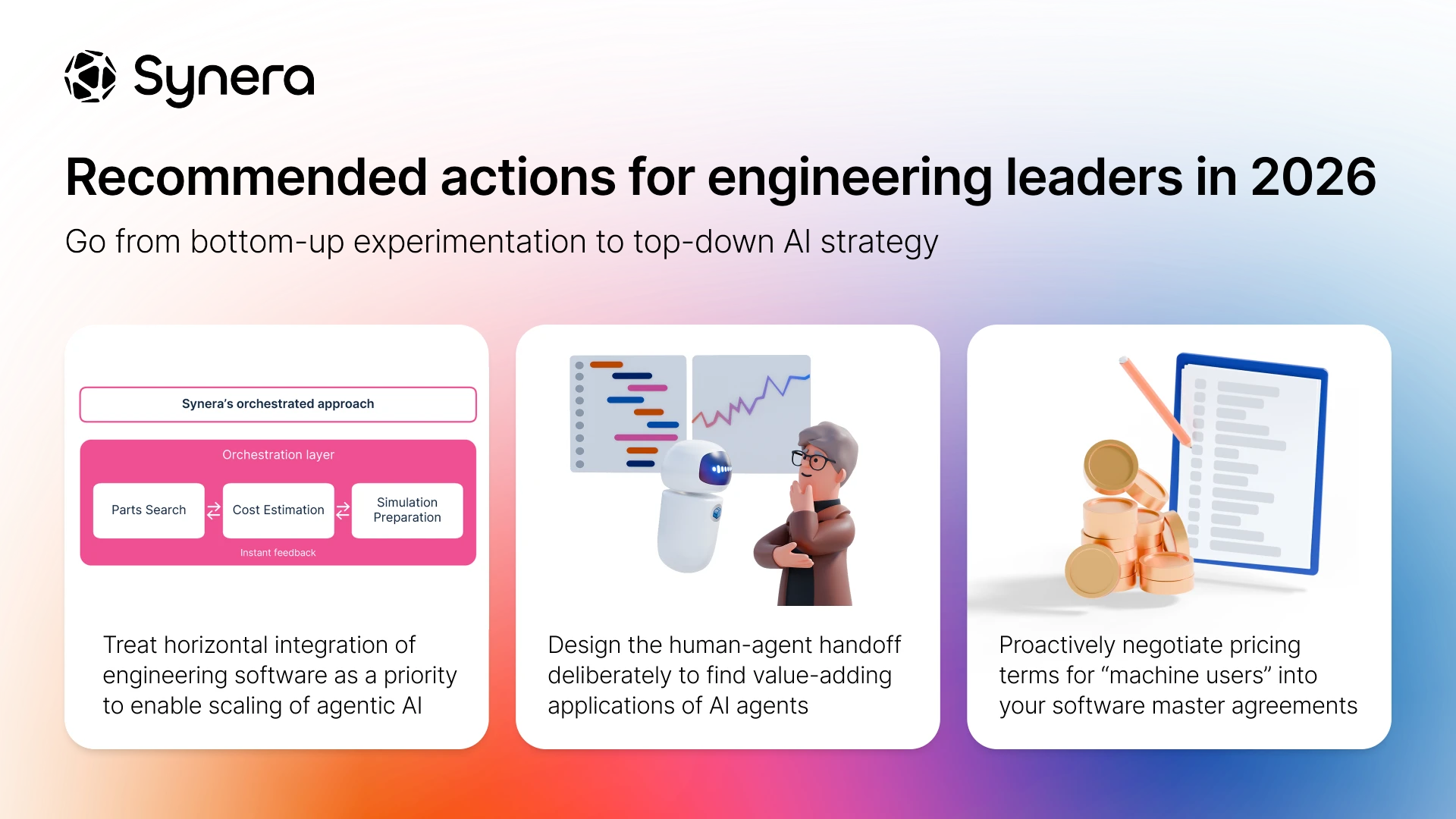
The consensus across all three is clear enough to act on: Build the data foundation and design the human-agent handoff deliberately. Leadership guidance to find value-adding applications of AI is key. Treat horizontal integration as a priority. It is the whole point if you are going to scale the gains of AI. And don’t let software costs creep up as agentic AI adds “machine users” to your organization. Proactively negotiate pricing terms for machine users into your master agreements ahead of vendors’ standardized terms.
Watch the webinar with Dirk, Ram, and myself to hear how these predictions unfolded in real time, or explore how Synera AI agents work in engineering.
FAQs about AI trends in engineering and manufacturing
What is agentic AI in manufacturing?
Agentic AI refers to autonomous or semi-autonomous software entities that use large language models (LLMs) and pre-defined skills/instructions to perceive, make decisions, take actions, and achieve goals in their digital or physical environments. They can be standalone agents working with specialized tools and roles to carry out workflows or even be a team of agents consisting of multiple specialized agents that work together in real-time, collaborating with each other’s results to deliver a detailed and cohesive output to the engineering operation. In aerospace and automotive manufacturing, this architecture enables AI to autonomously coordinate across complex, multi-step engineering workflows in ways that go far beyond traditional automation.
Will AI replace engineers in 2026?
No, AI will not replace engineers in 2026, and the companies that treat AI as a collaborative workforce rather than a replacement will see the strongest returns. Both Gartner and Synera experts emphasize that employees need training in how to design agent workflows, supervise their operation, and collaborate effectively with automated systems, and new roles such as agent architects, performance engineers, and oversight specialists are already emerging. According to Accenture and Synera leaders, the strategic priority should lie in building human-AI collaborative functions: organizations that invest in structured training programs and thoughtfully designed AI pilot programs today are best positioned to deliver long-term operational impact and sustainable ROI.
What is the prediction for AI agent costs in 2026?
Gartner predicts that by 2027, the cost-to-value gap in process-centric service contracts will be reduced by at least 50% due to agentic AI reinvention. For engineering units in manufacturing organizations, this signals real near-term financial upside, but realizing it depends on strategic deployment. Gartner recommends agentic AI only be pursued where it delivers clear value or ROI, which means engineering teams should focus on identifying high-value, well-defined use cases such as simulation automation, predictive maintenance, or design iteration, before scaling broadly.
How much production will be handled by AI agents by 2030?
Autonomous AI agents will play a significant role in manufacturing operations by 2030. Gartner predicts that 50% of cross-functional supply chain management solutions will use intelligent agents to autonomously execute decisions, and at least 15% of day-to-day work decisions across enterprises will be made autonomously by agentic AI by 2028, up from 0% in 2024. Now is the time to integrate agentic AI into production planning, procurement, and quality workflows to stay ahead of the curve.
About the author:

Daniel Siegel is the co-founder and managing director of Synera, a company reimagining how engineers create by helping them to build digital co-workers that think and collaborate like humans. With more than twenty years of experience in software development and engineering, he has helped some of the world’s leading companies in automotive, aerospace, and consumer goods rethink how products are designed and built. Having studied across six countries, Daniel brings a global perspective to technology, creativity, and innovation. Holding a Master’s in Business & Engineering and a Nanodegree in Deep Learning, he combines technical expertise with entrepreneurial vision — driven by one mission: to empower every engineer to shape the future.