Rib Placement Shouldn't Be a Manual Problem
For engineers designing injection-molded parts and lightweight structures, rib geometry is one of the most consequential decisions in the design process, and one of the most tedious to execute.
Getting ribs right means knowing where the load paths are, selecting the right cross-section profile for the manufacturing process, placing geometry that won't cause sink marks, warpage, or tool ejection issues, and updating every reinforcement manually when the design changes. For a seasoned engineer, that process is guided by hard-won intuition. For everyone else, it's guesswork — trial and error that multiplies CAD hours and raises the risk of parts that are over-built or underprepared.
Either way, it's slow, disconnected from the simulation data, and starts over from scratch with every design change.
For automotive and aerospace programs where part weight, tooling cost, and structural performance are all under pressure simultaneously, that gap between simulation insight and manufacturable geometry is a real drag on development speed.
Simulation-Driven Rib Generation, Ready for Manufacturing
The AutoRib add-in, developed by Alfred-Wegener-Institute, closes that gap directly inside Synera. Engineers input a Principal Stress Map, select a rib profile, and AutoRib generates a structurally optimized reinforcement network, placing material where the load paths actually are, in a form that is geometrically viable for the target manufacturing process.
The AutoRib add-in supports:
- Stress-guided rib networks driven by Principal Stress Map inputs
- Multiple cross-section profiles — trapezoidal, semicircular, and more — for injection molding feasibility
- Bio-inspired patterns and corrugated surfaces for lightweight structure design
- Specialized features including bosses and gussets
- Fully parametric geometry that updates automatically as design inputs change
"Every partner we add to Synera deepens what's possible across the engineering value chain, and AutoRib is a high-impact one. Bridging the gap between structurally sound designs and economically manufacturable geometry has always required manual effort. Synera’s AI agents are able to call workflows to do this autonomously now, incorporating analysis into optimized geometry, without the time-consuming handoffs in the middle of the design process."
— Andrew Sartorelli, VP of Software Partnerships at Synera
From Stress Map to Structural Geometry: A Real Automotive Example
Consider a structural engineer designing the internal panel of a car door. The panel needs to resist buckling under lateral load without adding unnecessary weight. A classic lightweight design challenge for injection-molded automotive parts.
Without AutoRib
- Manually interpret Principal Stress Map from FEA results
- Estimate rib placement based on experience
- Hand-model each reinforcement in CAD
- Select cross-section profile manually
- Rebuild geometry from scratch when the load case or panel shape changes
With AutoRib
- Input Principal Stress Map into the Stress-guided Ribs node
- Select cross-section profile and dimensions from a dropdown
- Connect to panel geometry: AutoRib generates the full reinforcement network
- When inputs change, geometry updates automatically throughout the model
The result is a structurally optimized, lightweight part delivered in a single workflow step, directly traceable back to the simulation data that informed it.
Autonomous by Design: AI Agents That Work at Top Speed
The AutoRib add-in is fully parametric within Synera. Adjusting stress inputs, rib dimensions, cross-section type, or panel geometry automatically propagates through the reinforcement network.
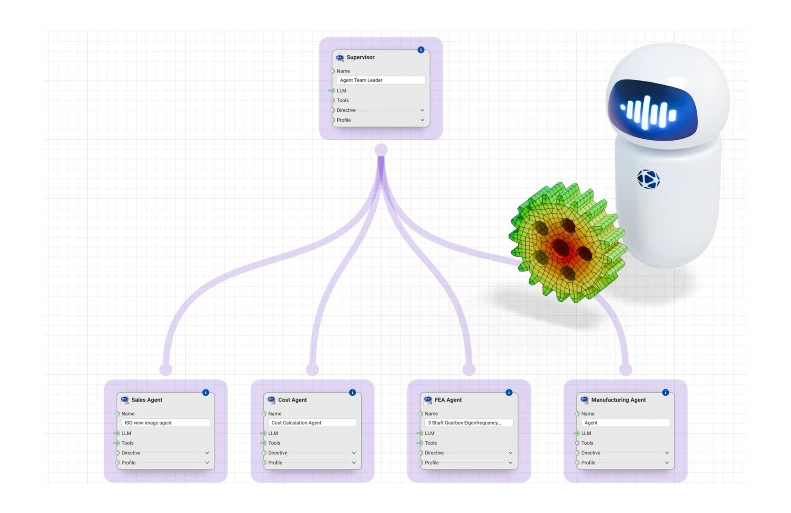
But the bigger shift comes when AutoRib is combined with Synera’s AI agents. Agents can trigger workflows utilizing AutoRib, process updated stress data, regenerate rib geometry, and output revised models as part of a continuous design-simulation loop, without requiring an engineer to manually step in at each cycle. Engineers can rapidly explore multiple outcomes, from conventional rib concepts to bio-inspired lattice patterns, and the agent handles the geometry work while the engineer stays focused on higher-level decisions.
This removes one of the most persistent handoff problems in designing automotive/injection molded components: the manual re-interpretation of simulation results to inform CAD geometry choices. With AutoRib inside Synera's agentic environment, that process becomes automated and traceable.
"AutoRib was built to give engineers a direct connection between their simulation data and their rib geometry. Inside Synera's workflow environment, that connection becomes self-improving. Design inputs automatically drive geometry, and the results are ready for manufacturing from day one. Combining that with Synera's AI agent capabilities means the entire process can run at a pace and scale that wasn't previously possible."
—Aniket Angre, AI Software Engineer at Alfred-Wegener-Institute
The ROI: Faster Iterations, Lighter Parts, Fewer Manual Steps
The immediate value is development speed. Structural rib designs that previously required manual interpretation of stress results, hand-modeling, and repeated rework can now be generated and updated in a fraction of the time, enabling engineers to explore more design alternatives within the same schedule.
Beyond speed, the quality difference: Stress-guided rib placement removes the guesswork from reinforcement design, resulting in parts that are structurally justified, weight-optimized, and manufacturable from the start. Engineers get from stress results to validated geometry faster, with fewer iterations between CAD and analysis. And because Synera's AI agents can autonomously utilize AutoRib workflows, the process scales across the entire engineering organization.
Built for Structural and Manufacturing Engineers in Automotive and Aerospace
The AutoRib add-in is designed for mechanical, structural, and manufacturing engineers working on injection-molded parts and lightweight structures in the automotive and consumer goods industries. If your process today involves repeatedly translating simulation data into rib designs, AutoRib eliminates the manual effort that slows it down.
Visit the Synera Marketplace to install the AutoRib add-in or contact your IT organization’s department.