TL;DR: Most AI tools engineers encounter today were built for general tasks. They can't connect to your tools, run your workflows, or make engineering decisions autonomously. This article explains what AI agents for engineering actually are, how purpose-built engineering agents work, and why Synera's on-premises platform is designed for the specific demands of mechanical engineering.
AI agents for engineering are reshaping how engineering teams work. Here's exactly what they are, how they differ from general-purpose tools, and why purpose-built engineering agents are the ones that actually deliver results inside real workflows.
AI agents are not chatbots
The term "AI agent" gets used loosely enough to mean almost anything right now. Chatbot, copilot, assistant, workflow tool. They're often bundled together as if they're the same thing. They aren't.
An AI agent for engineering isn't just a more capable chatbot. At its core, it combines four things: a large language model (LLM), a defined set of instructions that govern its role, a knowledge base that gives it access to relevant data, and memory that allows it to improve over time as it executes tasks.
That last point matters more than it might seem. A chatbot responds. An AI agent acts. It plans, sequences steps, calls tools, and delivers results. It can retrieve data and execute workflows, not just generate text in response to a prompt.
For engineering teams, that distinction is everything.
Why general-purpose AI agents fall short in engineering
Most of the AI tools engineers encounter today were built for general use cases: writing, summarizing, coding. They're useful, but they don't understand the context of a Finite Element Analysis (FEA) simulation, a Computer-Aided Design (CAD) parametric model, or a costing workflow that pulls from Systems Applications and Products (SAP) and a product catalog simultaneously.
General-purpose agent builders exist for IT and business workflows. They simply weren't designed for the deterministic, tool-specific demands of mechanical engineering.
Engineering work is constraint-driven, tool-heavy, and deeply process-specific. A workflow for analyzing load conditions might start in CAD, pass geometry to a meshing tool, run an FEA solver, extract results, and write outputs to an Excel report. That's five tools and five manual handoffs before a usable result. A cost analysis might require pulling live data from 3D geometry, Excel sheets, and an ERP system at the same time.
General-purpose AI can't orchestrate that. It doesn't have access to your tools, it doesn't know how your workflows are structured, and it has no mechanism to act inside your engineering environment.
To understand what purpose-built looks like in contrast, see how Synera's agentic AI platform for engineering is built.
What makes a purpose-built engineering agent different
A purpose-built AI agent for engineering, like the agents built on the Synera platform, goes further than a general LLM setup. In addition to the core components of any AI agent, it also has direct access to the tools and workflows that represent your organization's actual engineering processes.
That means it can do more than answer. It can run your workflow.
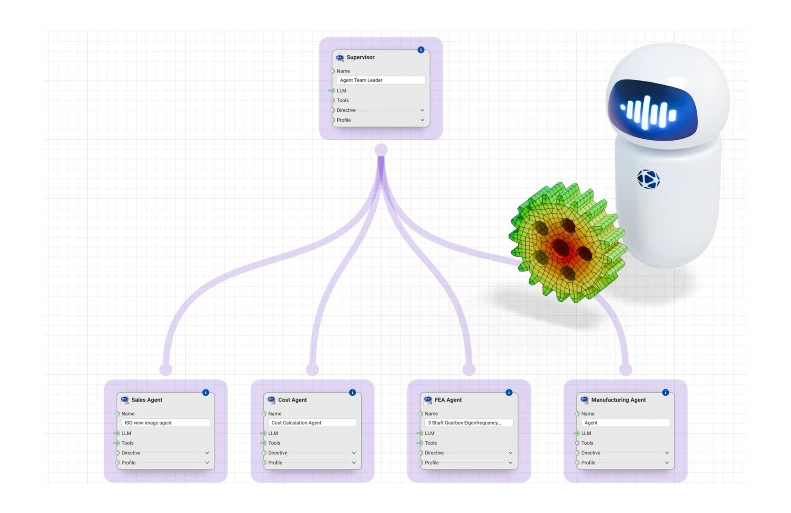
Synera agents can call on over 80 engineering tool connectors, including CAD, CAE, SAP, and product catalogs, through pre-built workflows on the Synera marketplace. When an engineer sends a prompt to update load conditions across a complex simulation workflow, the agent handles the tool calls, the data transfer, and the iteration, freeing the engineer from switching between environments.
The same applies to cost analysis. Instead of waiting on data from multiple departments, a Synera Cost Analysis Agent can extract information from 3D designs, Excel files, SAP, and product catalogs simultaneously, returning a cost breakdown in minutes rather than waiting on manual consolidation across teams.
Specialist agents can also work collaboratively, with one handling design, another running structural analysis, and a third reviewing outputs, functioning as digital coworkers across the full engineering process.
And because Synera is built for engineers to configure themselves, the workflows reflect your exact process, not a generic template.
That is agentic AI for engineering: the system makes decisions, not just executes predefined scripts.
From 3 days to 10 minutes: what this looks like in practice
A Tier-1 automotive parts supplier wanted to move faster on RFQs without adding headcount or lowering their engineering bar.
Before Synera, their RFQ process took three days. Data had to be pulled from multiple sources, passed between teams, and consolidated manually before a bid could be prepared.
With a purpose-built AI agent for engineering connected to their existing stack, that same process now completes in 10 minutes.
The engineers didn't change. The standards didn't change. The bottleneck, manual coordination across disconnected tools, was removed.
That's the operating model agentic AI for engineering makes possible.
See it in action: watch Mike build workflows and agents live
Reading about how agents work is one thing. Watching them run inside a real engineering interface is another.
Mike, Synera's Head of Pre-Sales Technical Consulting, answered the questions engineering teams ask most often before deploying AI agents, including the ones about security, data exposure, and what the platform actually looks like to use, with a live demo of the Synera interface while building workflows and agents in real time.
Watch the full FAQ video series on YouTube (7 videos, on demand)
The series covers: what an AI agent actually is, how Synera agents connect to your engineering stack, whether the LLM provider ever sees your data, and what the workflow builder looks like from the inside.
How the Optimization Agent demonstrates agentic AI in practice
The RFQ example illustrates speed. Synera's Optimization Agent illustrates something different: autonomous decision-making in iterative engineering work.
Traditional optimization involves manually varying parameters, re-running simulations, reviewing outputs, and repeating, sometimes dozens or hundreds of times. It's time-consuming, prone to human error, and creates bottlenecks that slow down the entire development cycle.
The Optimization Agent takes on that iteration loop autonomously. It controls workflow parameters, tests configurations against defined constraints, and systematically drives toward measurable improvements in weight, cost, or production time, without requiring manual re-runs.
The engineer decides where to push. The agent does the pushing.
AI agent security: what engineering teams actually need to know
One of the most legitimate concerns engineering teams raise when evaluating AI platforms is data security. In automotive, defense, and manufacturing, sensitive design files, simulation data, and proprietary workflows cannot be exposed to third-party AI providers. The consequences of a data breach, or even a perceived risk, can halt adoption entirely, regardless of how useful the tool is.
Synera's architecture was built with those requirements in mind. The platform runs on your own infrastructure. Every file shared through the platform stays on your server: none of it reaches the LLM provider. (For a deeper look at how this works, read AI agents in engineering: from single models to scalable agentic systems.)
Synera's security posture covers three areas:
- On-premises deployment. Runs entirely on your own infrastructure, private, protected, and fully under your control.
- TISAX certification. The internationally recognized standard for automotive information security.
- Multi-user authentication. Role-based access controls give IT and engineering leadership full visibility over who can access what.
This is the architecture that makes agentic AI for engineering viable in regulated industries, not just possible in theory.
From AI pilot to productive engineering teams with Synera
Engineering organizations have spent the last few years experimenting with AI. Pilots and proof-of-concepts have been valuable for building understanding. The teams seeing real competitive impact, though, are now moving beyond experimentation and integrating agents into how engineering work actually gets done:
- Automating repetitive iteration that used to consume entire engineering days
- Connecting tools that previously required manual handoffs between teams
- Freeing up engineers to focus on analysis and decision-making rather than data entry and coordination
For engineering leaders under pressure to do more with the same team, agentic AI for engineering is increasingly the answer to capacity questions that more headcount can't solve.
The foundation for that shift is understanding what AI agents for engineering actually are, and what separates a purpose-built engineering agent from a general-purpose tool. Synera was built with that distinction in mind.
If you want to go deeper on what this shift means for engineering leadership, read What Synera's $40M Series B means for engineering and What Gartner's AI research means for engineering.
Ready to see how it works inside a real engineering environment? Book a live demo or explore the Synera marketplace to see what your connected engineering stack could look like.
Frequently asked questions
What is an AI agent for engineering?
An AI agent for engineering is a system that combines a large language model with instructions, a knowledge base, and memory, enabling it to plan, make decisions, and execute tasks across tools and workflows. A purpose-built engineering agent also has direct connectivity to CAD, CAE, ERP, and other engineering tools, allowing it to act inside real workflows rather than just answer questions.
How does Synera differ from general-purpose AI tools?
General-purpose AI tools were built for writing, summarizing, and coding tasks. They have no access to engineering software or knowledge of your processes. Synera agents are purpose-built for mechanical engineering, connecting to over 80 engineering tools through pre-built workflows, and running on your own infrastructure so your data never leaves your environment.
Is Synera secure for use in automotive and defense?
Yes. Synera is TISAX-certified, runs on-premise on your own infrastructure, and supports multi-user authentication with role-based access controls. No data is sent to third-party LLM providers.