TL:DR
Is your engineering process ready for agentic AI, or are you about to invest in the wrong place? This article walks through why AI pilots fail in engineering, what the three levels of agentic AI look like in practice, and how the Synera Value Assessment gives you a clear, process-level answer.
91% of manufacturers plan to increase AI investment in product development (Aras, 2025), yet 56% of companies either do not measure AI value or rely only on qualitative assessments, meaning for the majority, AI impact is neither transparent nor steerable. (Porsche Consulting and Fraunhofer FIT, 2026)
Every major engineering organization is committed to sharpening its competitive edge with agentic AI. However, 80% of organizations running AI pilots in R&D fail to capture value, and the problem goes beyond the technology.

Synera's agentic AI systems are already in production, delivering measurable value to customers across automotive, aerospace, white goods manufacturing, and beyond.
It starts with three things:
- Identifying the processes that are genuinely ready for AI
- Finding the right balance between automation and agentic systems
- Building toward something that scales and delivers measurable ROI.
Read on to know how you can do this for your engineering processes.
Why most engineering AI initiatives stall
Agentic AI systems are fundamentally different from the automation tools engineering teams have worked with before. A rule-based workflow executes the same sequence every time, mostly within a single tool. Outputs are then manually transferred to the next step in the process.
An AI agent reasons, adapts, and coordinates across tools and decisions; it can run a simulation, interpret the output, decide the next step, and flag an anomaly, all without a human in the loop.
According to the McKinsey study, choosing the wrong AI use cases and opting for point solutions instead of an integrated platform are two of the major reasons that an AI pilot stalls.
The engineering teams that move fastest are not the ones with the biggest AI budgets. They are the ones that ask the right diagnostic questions before they build anything.
Introducing the Synera Value Assessment
The Synera Value Assessment is a focused, eight-question diagnostic designed for engineering leaders who want a clear, honest picture of where agentic AI fits in their operations, and where it does not.
It takes less than five minutes to complete. It covers the operational, knowledge, and strategic dimensions of your engineering workflows. And it produces a result that maps directly to the level of automation and AI complexity your processes can support today.
There are no wrong answers. Every response (Yes, No, or Sometimes) gives us insight into how your engineering processes are structured, where the friction sits, and where Synera can move the needle.
How to Get the Most Out of the Assessment
The assessment works best when you approach it with a specific process in mind rather than your engineering operations in general.
Pick one workflow that is either painful, slow, or strategically important. A good candidate is something your team runs repeatedly, involves more than one specialist or tool, and produces results that directly affect downstream decisions, a structural analysis cycle, a design variant, a cost optimization project, or a supplier RFQ response.

With that process in mind, each question becomes specific and answerable rather than abstract.
How does a filled assessment look like? - A worked Example of Request for Quotation (RFQ) response
To illustrate how the assessment works in practice, consider a common scenario in automotive and aerospace engineering: responding to a Request for Quotation for a structural bracket or load-bearing component.

Here is how a typical engineering team might answer each question for this process:
Do recurring workflows regularly take days or weeks to complete? Yes. A full RFQ response involving geometry review, FE simulation setup, material selection, and cost estimation routinely takes five to ten working days across multiple engineers and tools.
Does your team start from scratch for every variant? Yes. Each new RFQ arrives with different geometry, load cases, and material constraints. The previous simulation setup, despite being largely similar, is rarely reused in a structured way.
Can junior engineers execute complex tasks without senior guidance? Sometimes. Junior engineers can handle isolated steps (meshing, for example), but the end-to-end workflow requires a senior engineer to interpret results, make trade-off decisions, and validate assumptions.
Does your team manually transfer data between software tools? Yes. Geometry comes in from CAD, is cleaned and prepared manually, imported into the FE solver, results are exported to spreadsheets, and cost estimates are built separately, often by different people using different file formats.
Are critical workflows undocumented and dependent on internal knowledge? Sometimes. Individual engineers have developed their own approaches and shortcuts. When a senior engineer is unavailable, the process slows significantly or produces inconsistent results.
Could automation catch quality inconsistencies before they become problems? Yes. Mesh quality issues, boundary condition errors, and material mismatches are caught late in the process, often after significant time has been invested, because there is no automated validation layer.
Do multiple specialists need to review and adjust each other's work? Yes. Structural, thermal, and manufacturing engineers each need to sign off before the RFQ response is complete. Coordination across these specialists is a significant source of delay.
Would faster time-to-quote improve your competitive position globally? Yes. Reducing the RFQ cycle from ten days to two would meaningfully improve win rates and allow the team to respond to more opportunities without adding headcount.
Result: 6 Yes and 2 Sometimes answers.
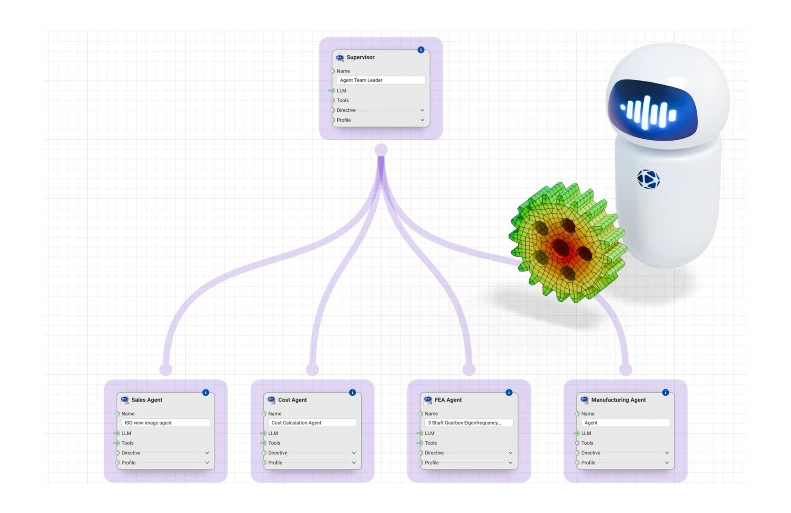
This team has a strong case for an agentic AI workflow with a team of agents from Synera to orchestrate the entire RFQ process. These agents handle everything from geometry intake and simulation setup through to result interpretation, cost estimation, and output formatting.Your engineering team interacts with a supervisory agent that manages the entire pipeline, receiving outputs in natural language that they can validate, challenge, or iterate as needed, staying in control while the system handles the execution.
What Your Score Tells You
The assessment produces one of three outcomes, each mapping to a different starting point with Synera:
3 to 4 Yes answers: Your team has clear automation opportunities in repetitive, manual processes. The priority is standardizing workflows and eliminating data transfer overhead togive engineers back time for higher-value work.
5 to 6 Yes answers: Your processes have significant knowledge bottlenecks and consistency challenges. Synera can encode expert knowledge into guided workflows, enforce best practices automatically, and make your top engineers' judgment available at scale.
7 to 8 Yes answers: Your engineering operations are a strong fit for multi-agent agentic AI systems. Synera can orchestrate complex, multi-step workflows end to end, from RFQ to production, with agents that coordinate tools, interpret results, and adapt to changing inputs.
Ask the right questions with Synera Value Assessment
The manufacturing, automotive, and aerospace industries are entering a period where the speed and quality of engineering output will increasingly determine competitive position. The organizations that build structured, scalable AI capabilities into their engineering operations now will hold a structural advantage that compounds over the next three years.
The assessment does not require a business case, a consultant, or a lengthy internal review. It requires five minutes and a specific process worth improving.

Agentic AI Readiness FAQs
When is an engineering process ready for agentic AI?
An engineering process is ready for agentic AI once the underlying workflows are documented, capturing internal processes, knowledge systems, and best practices in a structured, r epeatable format. Workflow automation is the foundation that agentic AI builds on, and Synera helps teams establish that foundation before connecting it to intelligent agents. Once the workflows are in place, the process is ready.
Is agentic AI the same thing as automation?
Automation is the foundation as it digitizes and standardizes how a process runs. Agentic AI builds on that foundation by adding the ability to reason, adapt, and make decisions across tools and process steps without being explicitly instructed at each point. Think of automation as the backbone and agentic AI as the intelligence that makes it adaptive.
Can agentic AI make engineers more efficient?
Yes, significantly. Synera customers have reported workflow time reductions of up to 90%, with engineers reclaiming hours previously spent on repetitive data preparation, manual tool transfers, and coordination tasks. That time gets redirected toward what engineers are best suited for: critical analysis, design decisions, and innovation.
What engineering workflows benefit the most from agentic AI?
Workflows that are complex, non-linear, and involve multiple tools or specialists benefit most, particularly where the next step depends on the result of the previous one.Processes like RFQ responses, simulation pipelines, and design-to-cost analyses are strong candidates, especially where expert judgment currently creates bottlenecks.
How long does it take to implement agentic AI in engineering?
A typical implementation takes six to eight months from the first pilot to production-ready deployment. Synera accelerates this through hands-on support from customer success manager, solution engineers, and forward deployment engineers, alongside structured onboarding through Synera Academy.
What size does an engineering team need to be before it makes sense to use agentic AI?
Team size is not the deciding factor, but the workflow and the industry challenge are. Agentic AI creates value wherever engineering processes are complex, repetitive, or dependent on knowledge that is difficult to transfer, regardless of team size.