Beyond the hype of agentic AI
Artificial intelligence (AI) and large language models (LLM), a type of AI designed to understand and analyze large amounts of data to generate human-like responses, dominate headlines, promising to revolutionize every industry. But in the high-stakes world of engineering where precision, safety, and reliability are non-negotiable, the hype collides with a hard reality.
While the AI market narrative focuses on cloud connectivity and data pipelines, the actual engineering landscape is a fragmented ecosystem of point solutions, with most engineering software vendors tackling narrow, vertical problems or isolated steps in the engineering process such as AI-accelerated design optimization. This creates the central challenge: How can engineering organizations orchestrate true, end-to-end agentic AI automation across a fragmented toolchain that lacks data pipelines?
Based on a deep analysis of emerging agentic AI solutions for manufacturing enterprises, the answer is not what most people expect.
The most impactful agentic AI for engineering solutions aren't about replacing engineers with smarter AI. Instead, a different, more pragmatic revolution is taking shape. Here are four takeaways that shape the true future of AI in engineering and set apart pilot attempts from solutions that deliver scalable value to win in markets where speed determines market share.
Four takeaways:
- The biggest risk isn't choosing the wrong tool, it's sticking with the status quo while others move faster with agentic AI.
- Engineering needs accurate and reliable tools that can follow structured steps and connect to the computer-aided design, engineering, manufacturing (CAx) and product lifecycle management (PLM) software teams already use.
- The most valuable systems help capture expert knowledge and turn it into reusable processes others can apply.
- Look for agentic AI platforms that connect across different tools to automate complete engineering processes end-to-end, without locking you into one vendor.
1. What agentic AI solutions are engineers using?
The AI agents for engineering market is so new that the primary challenge isn’t choosing the wrong agentic AI solution. It's the status quo: entrenched manual processes and fragmented tooling. Or it’s confusion about agentic AI for solutions that don’t focus on specialization in engineering and haven’t delivered in-production results for engineering organizations. For Synera, this means our main task is market education.
Analysis of our sales calls reveals a telling insight: when customers mention established vendors like Siemens or Dassault, they aren't citing them as direct alternatives. Instead, they use these familiar names as conceptual anchors to better understand this entirely new category of AI agent engineering technology and the challenges of connecting fragmented software programs.
The sheer heterogeneity of other tools mentioned in conversations, spanning from simulation and process integration and design optimization (PIDO) platforms to non-engineering IT automation tools like Flowise, Microsoft Copilot Studio or n8n, manufacturers are still trying to define their strategies for agentic AI. The data confirms this: Synera lost only 4% of potential customers in 2025 to an indirect competitor.
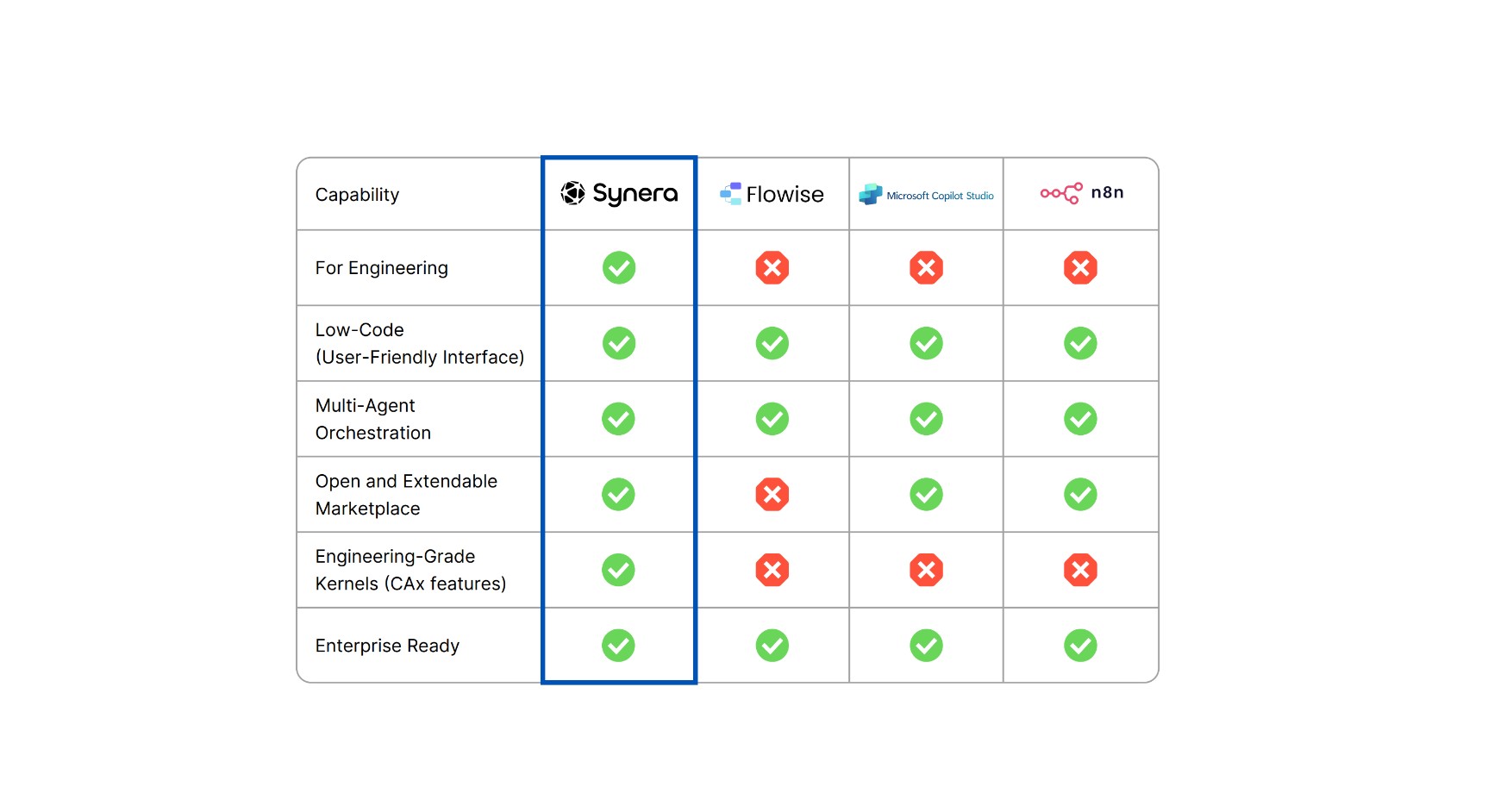
The primary “competitor” we see is inertia. Without a clear strategy, companies struggle to align their resources or vision to build an agentic team and therefore talk the initiative to sleep internally.
2. Why are deterministic agents critical for making agentic AI work in engineering?
While public attention is fixed on generic AI agents and copilots that process call logs and documents for areas like call centers and legal services, the engineering sector requires more complex analyses and tool orchestration. In a field where a miscalculation can have catastrophic consequences, generic AI or “one agentic solution for all departments” represent an unacceptable risk. The real breakthrough Synera introduced to the market lies in a more disciplined approach: deterministic AI agents for engineering.
These agents are less susceptible to hallucination. They act as specialized orchestrators, executing complex workflows by calling upon existing, trusted engineering tools and solvers that engineers already rely on. The agents inherit the precision and validation from the tools and methods engineers already use, while at the same time connecting fragmented tools into a single automated fabric across engineering domains.
To remain competitive in markets where cost and speed pressures increasingly determine the market share of new products, engineering needs to digitize processes to enable the benefits of AI: fast and cost-efficient scalability. Digital engineers simply work more quickly, enabling more design exploration and completing repetitive cross-domain tasks like design-to-cost in minutes, instead of days or weeks. And they can be cost-effectively cloned.
In regulated industries (auto, aerospace, defense), deterministic workflows and connection to trusted tools is a must-have strategy for agentic AI solutions in the engineering space.
3. Why is the ultimate strategic edge is digitized engineering expertise and not tools?
The most durable competitive advantage in this new agentic AI market isn't a proprietary algorithm in software; it's the accumulation of compounding process intellectual property (IP).
Every time a subject-matter expert uses an agentic AI solution like Synera to build an automation workflow, their domain knowledge is captured and codified into a reusable, digital asset.
Over time, this process creates an invaluable library of digitalized expert workflows. Knowledge is democratized as these workflows become part of the organization’s core operating procedures. As Synera’s library of workflows grows – already over 100,000 strong – we're able to speed up time-to-value for every new customer.
This accumulated knowledge helps Synera and our customers continuously refine what effectively digitalized engineering processes look like, enabling our services team to improve automation recommendations for all platform users.
4. Why does vendor neutrality matter when deploying agentic AI at scale?
Large, single-vendor software suites like Altair/Siemens, Synopsys, and Dassault have a fundamental weakness: their core business incentive is to lock in customers, not orchestrate competitors' tools. This limitation creates a massive opportunity for connected engineering platforms like Synera that can serve as a neutral, vendor-agnostic orchestration layer.
Real-world engineering processes are rarely confined to a single software. They inevitably cross tools from different vendors, such as moving a design from CATIA to ANSYS and then into a PLM system. By serving as the essential “neutral orchestration” layer or "hub," Synera automates these critical end-to-end workflows that incumbents inherently cannot.
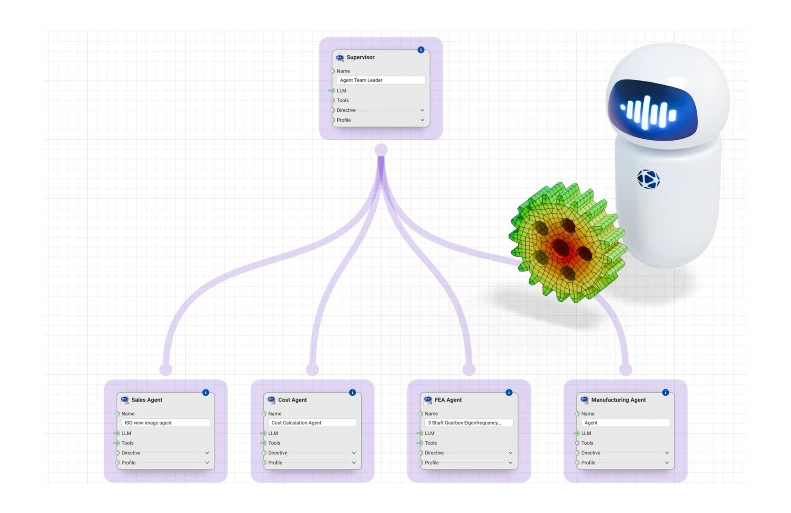
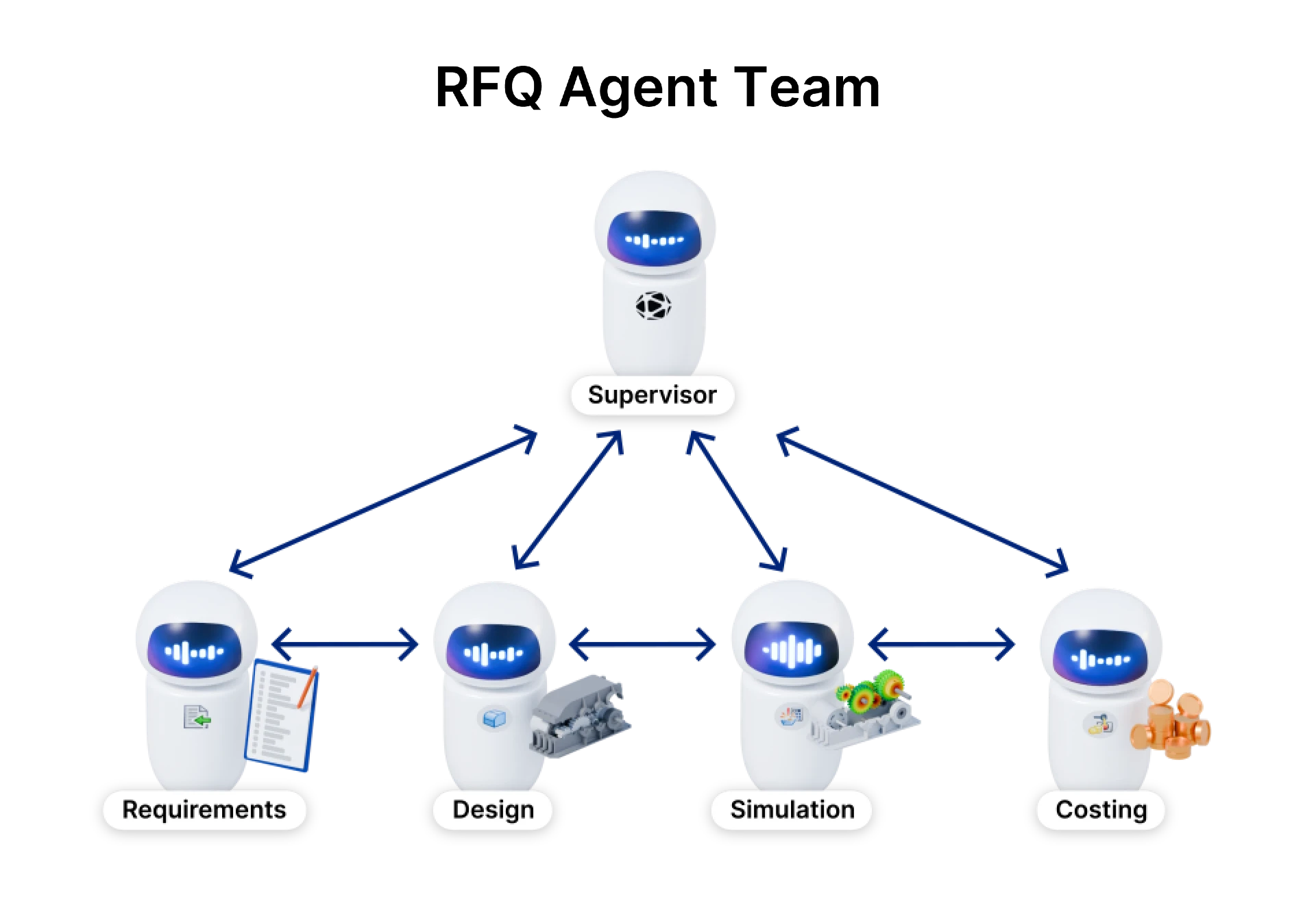
A clear example is a team of agents for an RFQs, where Synera coordinates four specialized agents handling requirements extraction, CAD design, manufacturing process planning, and cost estimation, each running complex workflows across multiple engineering tools. The result is a fully automated RFQ response completed in hours, with no need for manual tool handoffs.
Synera’s marketplace, which in turn deepens the platform's value and reinforces its indispensable, neutral position.
What is the real challenge and value of AI in engineering?
The true revolution of deterministic AI is that it completely reframes the adoption problems. Instead of forcing regulated industries to validate an opaque, black-box AI, Synera leverages the tools and processes engineers already trust. This shifts the primary challenge manufacturers face from one of agentic AI trust to one of organizational adoption and change management. A far more surmountable obstacle.
The real value is building a reliable framework that allows engineering expertise to be codified, automated, and scaled.
As digital engineers become the trusted connective tissue for organizational charts, what happens is a multiplication of the company's most valuable IP: the final product designs and the automated processes that help create them.
Knorr-Bremse offers a glimpse of what’s possible when engineering teams start working this way.
About the author:
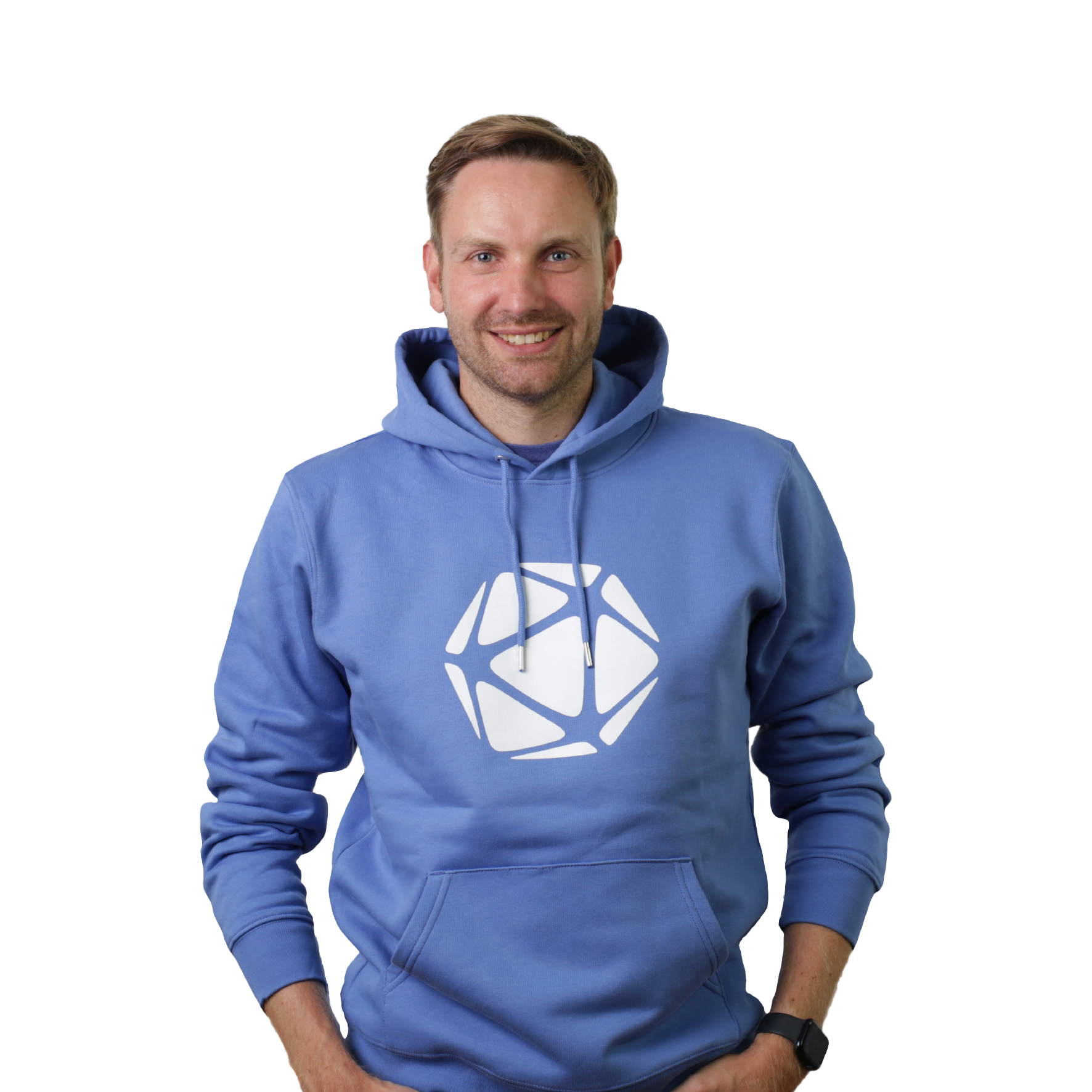
Daniel Siegel is the co-founder and managing director of Synera, a company reimagining how engineers create by helping them to build digital co-workers that think and collaborate like humans. With more than twenty years of experience in software development and engineering, he has helped some of the world’s leading companies in automotive, aerospace, and consumer goods rethink how products are designed and built. Having studied across six countries, Daniel brings a global perspective to technology, creativity, and innovation. Holding a Master’s in Business & Engineering and a Nanodegree in Deep Learning, he combines technical expertise with entrepreneurial vision — driven by one mission: to empower every engineer to shape the future.